Home > Articles on Notable People > Bernard Barton – Quaker Poet
Bernard Barton the ‘Quaker Poet’
Introduction
Bernard Barton (1784-1849) was a Quaker and a minor poet who earned his living as a clerk in Alexander’s bank at Woodbridge (now Barclays). Barton, who came to Woodbridge in 1806, often considered giving up his job to write poetry full time but Lord Byron, Charles Lamb and others discouraged him from doing so.
Barton’s many volumes of verse now gather dust in the archives, but in his day he was widely known as ‘the author of much pleasing, amiable and pious poetry, animated by feeling and fancy, delighting in homely subjects, so generally pleasing to English people’. He sang of what he loved – the domestic virtues in man, and the quiet pastoral scenes of Nature – its woods, and fields, and lanes, and homesteads, and the old sea that washed its shores. The nearer to his own home the better he loved it. Barton never thought that his verse rose to great heights. His desire was ‘to be a household poet with a large class of readers’.
Barton won the affection of a large circle of friends including many leading literary figures such as Edward FitzGerald, Charles Lamb and Robert Southey. His numerous letters to them are now valued above his poetry.
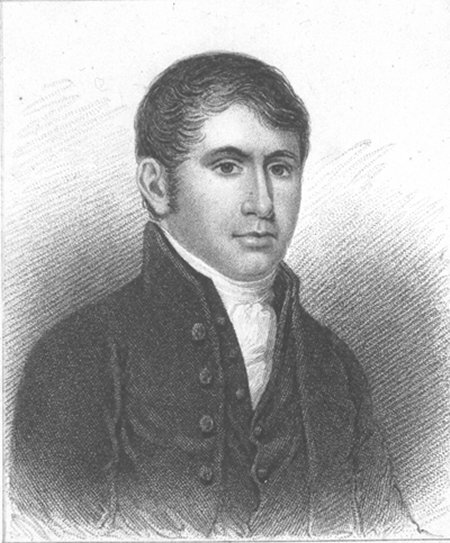
An engraving of Bernard Barton when he was a young man.
Barton’s early life
Bernard Barton’s father, John, was a Quaker who inherited a manufacturing concern in Carlisle. He was also one of the twelve men who, in May 1787, formed the London Abolition Committee to campaign against slavery and the slave trade. He married Mary Done from a Cheshire family.
Bernard Barton was born at Carlisle on January 31st 1784. His mother died a few days later. His father married again, while Bernard was an infant, but he died in 1791. Bernard and his two sisters were brought up by his step-grandparents in London. His step grandfather was a well to do Quaker merchant and Barton was eventually sent to a Quaker boarding School at Ipswich.
At fourteen Barton began a 7 year apprenticeship with Samuel Jesup, a shopkeeper at Halstead in North Essex. In 1806, after 8 years behind the counter of a corner shop he moved to Woodbridge and became a corn and coal merchant in partnership with Alexander Jesup, the son of the brother of Barton’s former employer. By 1807 Barton had married Lucy Jesup, the daughter of his business partner. She died a year later giving birth to their daughter Lucy who lived with her Jesup grandparents until she was 16.
After the death of his wife, Barton could not bear to stay in Woodbridge. He moved to Liverpool for a short time and accepted the position as private tutor in the family of Mr Waterhouse, a merchant. It was there that he met William Roscoe who lent him books and encouraged his writing. Later Barton would dedicate his first volume of verse to him.
Barton’s return to Woodbridge
In 1810 Barton returned to Woodbridge as a clerk in the bank of Dykes and Samuel Alexander, an office he discharged until a few days before his death 40 years later. The Alexanders were a Quaker family who founded a bank in Needham Market in 1774. It was one of the first private banks to be established in England and it still continues as part of Barclays Bank.
Barton’s mother-in-law was from the Alexander family and it is probable that he obtained his position at the Woodbridge branch of the bank through her influence.
While his infant daughter was being looked after by her Jesup grandparents, Barton moved digs several times until he found himself feeling at least temporarily ‘at home’ with Anne Knight, a Quaker widow, who was helping her two sisters run a school for Quaker girls in Cumberland Street.
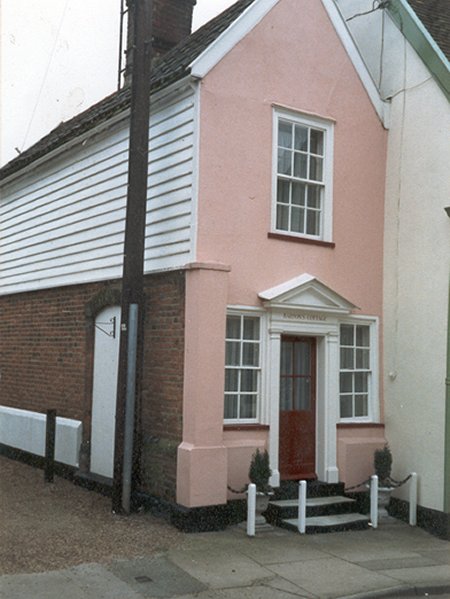
In the summer of 1824, when Lucy was 16, she and her father set up home together in a cottage in Cumberland Street. Barton referred to it as ‘my own nutshell of a house which, within the next few years will become as full of prints and pictures as I can hang it’. The townspeople called it Poet’s Corner.
Barton and Lucy left the cottage in 1835 and moved into the bank house, part of what is now Barclays Bank. Their new accommodation had a bigger sitting-room for Barton’s pictures, a study for his books, and an entrance from the Thoroughfare.
Poet’s Corner on Cumberland Street. It was home to Bernard Barton his daughter Lucy from 1824 to 1835
The Man
The Poet and Correspondent
After Barton’s first volumes of verse, ‘Metrical Effusions’ was published in 1812, Byron wrote to him saying ‘Do not renounce writing, but never trust entirely to authorship …. If others think as well of your poetry as I do, you will have no cause to complain’.
Barton second volume of verse ‘Poems by an Amateur’ was published in 1818 and it received a warm, enthusiastic response from Charles Lamb. Barton had originally written to Lamb on behalf of the Quakers, to protest against comments made about them in some of Lamb’s essays, and they entered a monthly correspondence from 1822 to 1830 when Lamb’s health began to break down. When Barton proposed to leave the bank Lamb responded with ‘keep to your bank, and the bank will keep you. Is there not from 6 to 11 pm six days in the week, and is there not all Sunday’. This kept Barton going, though his labours in the bank were often 9 am to 9 pm.
Barton’s letters to Lamb and Byron were just some of the many he addressed to literary figures, including Walter Scott, Robert Southey and William Bodham Donne. His numerous letters to them are now valued above his poetry. He also wrote, or sought introductions, to anybody in the area who had literary pretensions. Actions that have lead some to express the view that Barton was a poor poet, who pestered the famous for praise and support.
Barton’s third volume ‘Poems’, published in 1820, had run to the 4th edition by 1825.
In 1824 the Society of Friends in East Anglia raised £1200 for Barton’s benefit. He was reluctant to accept it but Charles Lamb was emphatically in favour. About £1000 of this money was invested to produce regular income.
Between 1822 and 1828 Barton published a further five volumes of verse.
1822 – Napoleon and other poems
1822 – Verses on the death of P B Shelly
1824 – Poetic Vigils
1826 – Devotional Verses
1827 – ‘A Widow’s Tale’ and other Poems
1828 – ‘A New Years Eve’ and other Poems
His friends warned him of the danger of making himself too cheap with the publishers and the public, but this advice was ignored. ‘There was in Barton a certain boyish impetuosity in pursuit of anything he had at heart’.
Barton’s last three volumes of work were published towards the end of his life.
1845 – Household Verses
1846 – Seaweeds gathered at Aldeburgh in the Autumn of 1846
1848 – Verses at 64
Barton sent the Prime Minister, Sir Robert Peel, a number of poems to mark landmarks in the life of the country. In return, when Peel retired from office in 1846, he secured Barton a pension of £100.
Examples of his Poems
Upon almost any subject Barton could drop into a mood that he felt to be poetic inspiration: A Stuffed Eagle; Zechariah XIV.7; A Poet’s Memorial to Robinson Crusoe; hundreds of deaths, birthdays and views around Woodbridge; To Sir Samuel Fludyer on the devastation effected on his Marine Villa at Felixstowe by the encroachment of the Sea.
Of his life in Woodbridge Barton wrote:-
I came to the a stranger youth,
Unknowing and unknown:
And Friendship’s solace and Love’s truth,
In thee have been my own.
Loved for the living, and the dead,
No other home I crave;
Here would I live till life be fled,
Here find a nameless grave.
One of the most beautiful of the many poems that Barton addressed to his daughter is also a testimony to the sweet virtues of the mother he never saw.
My child, this is thy natal day,
..And might a father’s prayer
For thee inspire his votive lay,
..What blessing should’st thou share ?
Shall wit, or wealth, or beauty move
..Thy sire to bend his knee ?
I hold thee far too dear, my love,
..To crave these things for thee.
If wish of mine might prove of worth,
..Be this thy portion given,-
Thy mother’s blameless life on earth,
..Thy mother’s lot in heaven.
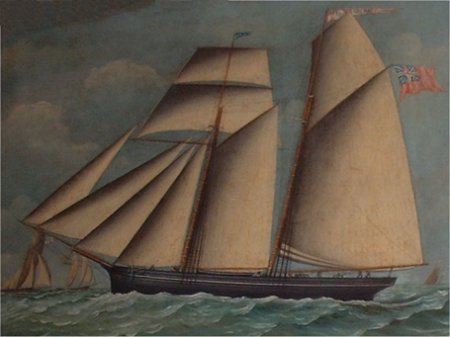
Some of townsmen took it into their heads to name a schooner. It was built at port and was named after their Woodbridge poet. Barton responded in verse:-
“To the Bernard Barton Schooner,”
Glide gently down thy native stream,
..And swell thy snowy sail
Before fair April’s morning beam
.. And newly waken’d gale.
Thine onward course in safety keep,
..By favouring breezes fann’d,
Along the billows of the deep
..Mersey’s distant strand.
Not all the glory those acquire,
..Who far for glory roam,
Can match the humble heart’s desire
..For love fulfill’d at home.
Barton's Only Reference to Slavery
Barton's later life and friendship with Edward FitzGerald
Barton first met Edward FitzGerald 1836 when his daughter Lucy took him to a house party as Boulge Hall. FitzGerald was then aged 28 and Barton 53. Despite the enormous difference in age they became close friends. Jeffrey Martin describes their relationship thus ‘the younger man played host, mentor, and critic to the older one and deriving thereby, quite possibly, a satisfaction that he could not find among his own true and competitive equals. The pair had common interests in both literature and art, but in addition, there was an easy camaraderie between Barton and FitzGerald that allowed them to tease each other affectionately without being offensive. Other aspects of Barton’s personality that must have delighted FitzGerald were his easygoing, unassuming nature and his unpretentious ways. Both disliked the trappings of high society.’ When FitzGerald was away from home he and Barton kept in touch by letter.
A year after their first meeting FitzGerald moved into in Boulge Cottage where he lived for the next 16 years. It was here that he entertained the ‘Woodbridge Wits’ – Barton, George Crabbe, vicar of the adjoining parish of Bredfield, and Thomas Churchyard, the Woodbridge layer and amateur artist. They met often to read favourite books together, and to discuss new ones, or to criticise each other’s latest acquired picture.
In 1848 Barton had discovered that almost all of his savings, ‘a little nest-egg of about a thousand pounds’, which he had entrusted to a relative for investment, had been lost and that the interest of £50 it brought in was ‘clean spunged out’. Barton was in poor health and knew that at his death his salary, his pension, and now his savings would all be gone, leaving Lucy penniless.
On the 19th Feb 1849, after two day’s sick leave from the Bank he had a heart attack and died. This had been a problem that had been building up for year. Barton had abandoned his habit of walking and had led a sedentary life taking ‘almost as little exercise as a milestone and far less fresh air’.
FitzGerald had visited Barton just before he died and promised that he would take care of Lucy. From there, marriage seemed a natural step, but it had to be delayed because FitzGerald’s father was facing financial ruin. They eventually married in 1856. By then FitzGerald and Lucy were aged 47 and 48. The marriage was a disaster from the start and they soon lived apart.
Soon after Barton died FitzGerald set about editing a volume of Barton’s poems to produce an income for Lucy. This involved considerable revision. FitzGerald had previously commented that Barton’s volumes ‘contained many pretty poems; but many that were very hasty, and written more as task-work, when his mind was already wearied with the labours of the day’. He also wrote that ‘Though not dashed off as easily as the letters, the poems were probably as little elaborated as any that were ever published. Barton wrote always with great facility, almost un-retarded by that worst labour of correction. He would never believe that there could be too much poetry abroad.’
Barton’s epitaph is probably best taken from an obituary in which FitzGerald wrote ‘Thousands have read his books with innocent pleasure – none will take then up and be worse for doing so.’
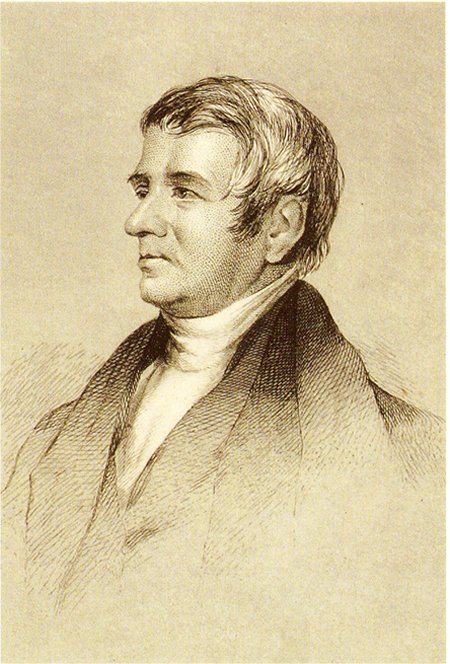
Bernard Barton 1784-1849
Sources
Bernard Barton and his Friends, A record of Quiet Lives, Edward Verall Lucas, 1893.
Memoir of Bernard Barton, Edward FitzGerald. In Selections from the Poems and Letters of Bernard Barton, ed. Lucy Barton, 1849.