Home > The Story of Woodbridge > Diversification of Religious Life
Diversification of Religious Worship
For many centuries all Christians worshiped in Catholic churches which were richly decorated with religious images and where services were conducted in Latin. During the sixteenth century pressure built up in the area which is now Germany for a religious transformation – the Protestant Reformation. There was a desire to recapture the vitality and freshness of the earlier Christian faith, as found in the golden age of its first centuries.
When Henry VIII came to the throne in 1509 he rejected the ideas behind the Reformation and he had no desire to change the church. It was the Pope’s refusal, in 1529, to allow him to divorce his wife, Catherine of Aragon, which drove him to gain the support of Parliament for a break with Rome. Over the next five years all ties with Rome were severed and Henry VIII became Head of the Church in England which could best be described as “English Catholic”. The mass and the other church rituals continued to be in the Catholic form but the Bible was read in English and not Latin.
After Henry VIII died the church became more Protestant during the Regency of his successor Edward VI. When Mary came to the throne in 1553 she set about restoring Roman Catholic beliefs throughout the country and instituted a savage persecution of Protestants. Mary’s successor Elizabeth I opted for a compromise. During her reign the churches looked more Catholic and many traditional Catholic ceremonies were retained but the liturgy was more suited to Protestants. The one thing that united these monarchs, and their successors James I and Charles I, was that they had the same ideal – a nation united under a single church. A single Church was what bound people together. The monarchs all resisted the calls of various groups to be allowed to worship in different ways.
Steps Towards Allowing Multiple Forms of Worship
During the reign of Elizabeth I, and of her two successors, there was a growing group of Protestants who sought to purify the Church of England – the ‘Established Church’, of its remaining Roman Catholic practices. By the reign of Charles I this group, known as the Puritans, had become a major force in Parliament and they took the lead in the dispute which eventually resulted in the Civil War. During the war, and the Commonwealth which followed it, parishes were encouraged to accept Puritan preachers and other religious groups, such as the Quakers and the Congregationalists or Independents, were formed.
When the monarchy was restored in 1660, Charles II strove for a broad based national church and toleration for those Protestants who felt that they could not be part of it – a group that became known as the Dissenters. However, he was soon forced by Parliament to demand strict conformity to the words and practices of the Established Church and to restrict the activities of Dissenters and Catholics.
Despite this setback Charles II continued to fight hard for toleration and, in 1672, he proclaimed an Indulgence which enabled preachers and preaching places to be licensed. Some 1,500 licences for meetings were issued and soon the first purpose-built chapels were constructed. Parliament was incensed and by 1681 the persecution of Dissenters was in full spate again. Some meeting houses were broken up and burnt; ministers died in gaol, or fled abroad.
It was not until 1689 that Dissenters were able to escape the penalties for either not attending the Established Church or for attending their own forms of worship. Although they were treated with more consideration they were still not allowed to be members of parliament, hold any government job, or even go to University. Widespread Anti-Catholicism prevented the lifting of the restrictions on Catholics at that time. Some of these restrictions were removed in 1778 and then in 1791. Those which remained were lifted by the 1829 Catholic Emancipation Act. This Act also removed remaining restrictions on the Dissenters, who by 1900 were known as Nonconformists.
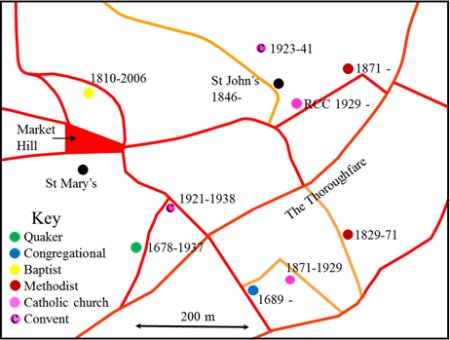
Locations of the New Churches and Chapels in Woodbridge
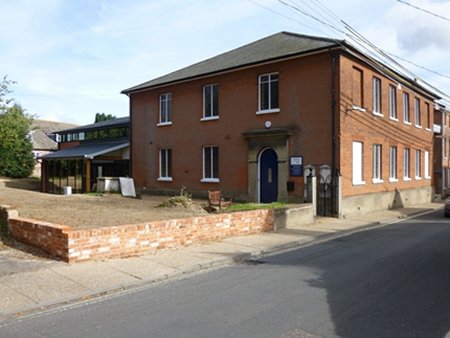
Quay Congregational Church
When the Civil War started Robert Cade, who had been minister at St Mary’s for nearly 20 years, was asked to yield the pulpit to a number of lay preachers or ‘lecturers’ at least two of whom were townsmen. Eventually the parishioners invited Frederick Woodall, a lecturer of Yarmouth, to come to Woodbridge.
By 1650 most of the parishioners at St Mary’s decided that they wanted the former minister back so Frederick Woodall, together with fifty five ‘brethren and sisters’, left St Mary’s and set up what was to become the Quay Independent Church. Not much is known about the early years of this church. It is believed that they held their first meetings in a room of The Ship Inn.
When Charles II proclaimed his Indulgence in 1672 Frederick Woodall was granted a licence to be the teacher of a congregation in the house of Jonathan Bass ‘for those who do not conform to the Church of England’ and who ‘are of the persuasion commonly called Congregational’. The Rev Woodall served the congregation as pastor until he died in 1681, by which time the persecution of Dissenters had started again. In the church book there is the entry – ‘It was a gloomy time for those who were left behind.’ All that is known about the next 8 years is that there was no minister. When the Toleration Act was passed in 1689 John Bass, purchased the piece of ground on which the Quay Congregational Church now stands. The first building to be erected on the site stood for 117 years and could seat 500. The present building was erected in 1805 and in the same year adjacent land was purchased for a burial ground. The building was subsequently altered in 1877 and 1897.
Article on Elizabeth Warren. A local woman who, from 1646-49, wrote and published tracts about the state of the Church of England.
Warren, Elizabeth (fl.. 1646-49), religious pamphleteer, known only by three pamphlets which she published over the period 1646 to 49. She apparently lived in Woodbridge, Suffolk, and may have been the wife of the Rev. John Warren, headmaster of Woodbridge school from about 1632. Her first tract was a defence of the ordained clergy against lay preachers, The Old and Good Way Vindicated (1646, two editions), and in 1647 she issued a long work entitled Spiritual Thrift, comprising a series of meditations on religious themes. This reveals her to have been a well-educated woman who knew Latin and wrote well. Her third work, A Warning – Peece from Heaven against the Sins of the Times (1649), was a lament on the breakdown of authority in the home, church, and state.
Unlike many female pamphleteers of the 1640s, Elizabeth Warren seems to have accepted a subordinate role for women even in spiritual matters. She published only reluctantly, ‘conscious to my mentall and sex-deficiencie’, and believed that women were more susceptible to error than men: ‘wee of the weaker sex, have hereditary evill from our Grandmother Eve’ and so were ‘created subordinate by divine institution’. She provides some insight into the difficulties faced by women who wanted to write: her own educational, social, and family commitments, together with poor health, she says, ‘put mee continually upon such imployments, as straightens my leisure in affaires of this nature’.
See also K. Thomas, ‘Women and the Civil War Sects’, in Past and Present, 13, 1958; E. M. Williams, ‘Women Preachers in the Civil War’, in Journal of Modern History, I, 1929.
The Quaker Meeting House
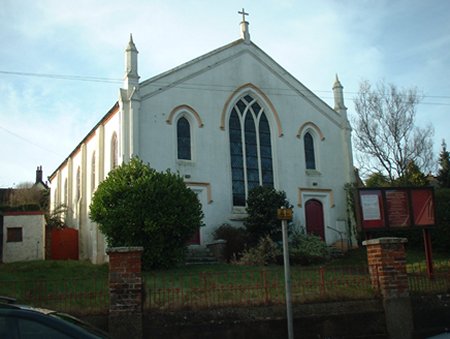
The first references to converts to the Quaker way of life and worship in south east Suffolk are from 1655. In that year George Whitehead and other Quaker evangelists, the ‘First publishers of Truth’, arrived in Suffolk and held meetings across the county. The first Woodbridge converts would have met together for worship and discussion in their own houses, not only in Woodbridge but also in some of the surrounding villages.
During 1678 a Meeting House was built in Turn Lane. This was some 6 years after Charles II had proclaimed an indulgence which enabled dissenting preachers and preaching places to be licensed and by then persecution of Dissenters was on the rise again. In December 1678, the Justices of the Peace issued an order to the Constables of Woodbridge complaining of ‘this Meeting House newly built near the Church’. Should five persons or more, of age of sixteen and upward, attempt to meet there the Constables were to ‘charge and command them peaceably to disperse and depart forthwith to their several homes and abodes, and not break His Majesty’s peace by meeting in such an unlawful manner.
When the Toleration Act was passed 1689 the Quakers were able to worship in the way they wanted, but this did not swell their numbers in Woodbridge or nationally. Between 1680 and 1800, the numbers of Quakers in Woodbridge fell by a half, with a further reduction of one third by 1860. In 1935 the Woodbridge Monthly Meeting regretfully came to the conclusion ‘that the time has come to close the meeting at Woodbridge where no regular Meeting for worship has been held for some time and where there are now only two members’.
The Methodist Chapel
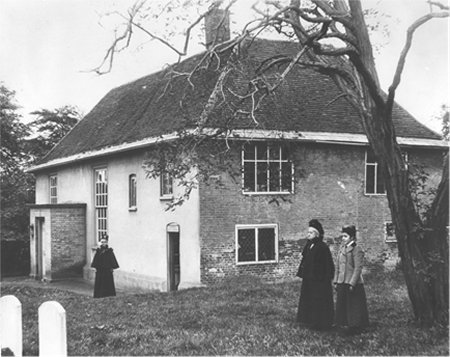
In 1812 a soldier drummer of the Lincolnshire Regiment, who was also a Methodist local preacher, was granted permission to hold services in the Woodbridge barracks. Later, services were held in two hired rooms in the town. Then, in 1829, a chapel was built in Brook Street. It is now a private residence (No. 20) having been replaced, in 1872, by the chapel on St John’s Street.
When the new Methodist Chapel was opened it could seat 350. The interior of the church was subdivided, in 1963, to form a school room and a smaller sanctuary. Further changes were made in 1972 and then, in 1990, a new church hall was built on the side and it was thereby possible to bring the sanctuary back to its original size.
St John’s Church
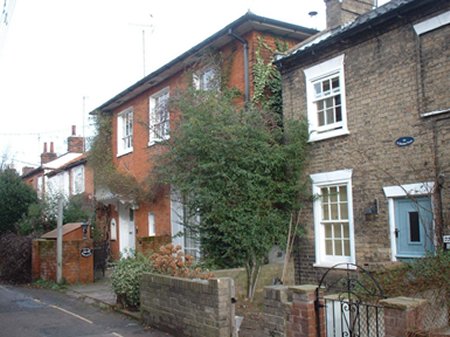
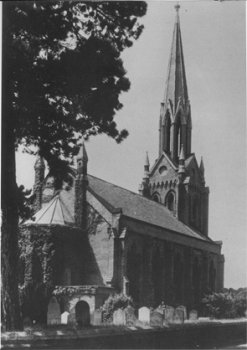
St John’s Church was built as a result of the energy of the Reverend Henry Hardinge. He became rector at St Mary’s in 1839 and his preaching filled the church to overflowing. He then started the project of building a new church or ‘chapel of ease’ on part of some former grazing land at the bottom of Castle Street. This land, which had been put up for sale in 1840, had previously been rented for grazing. Within two years £2,600 had been raised to build the church. The foundation stone was laid in June 1842 and the church was eventually consecrated in 1846.
The church originally had a tower topped with an elegant spire rising to the height of 138 feet but the spire had to be removed, in the 1970s, because the iron bars used to reinforce the stonework had corroded. The remaining stumpy tower never looked right but this was rectified when an anonymous benefactor came forward to fund a new spire which was erected in 2003.
St John’s Church with its original spire.
St Thomas of Canterbury Roman Catholic Church
The renaissance of Catholicism was slow to arrive in Woodbridge. In 1770 there was only one Roman Catholic living in the town out of a population of 2331. By 1801 there were 4 in a population of 3020 and the town remained strongly anti-Catholic. The bells of St. Mary’s, Woodbridge, were pealed in protest when the Catholic Emancipation Act was passed in 1829.
A celebration of Mass ”as it was thought for the first time since the Reformation” was held in Dr Moore’s house in Church Street, on 22nd March 1865. Seven years later a Catholic Church was built, in 1872, in Crown Place, as a result of a donation by a priest in Ipswich. However, the small number of Catholics in Woodbridge found it hard to raise enough money for the upkeep of the church and for the support of a resident priest. Sometimes they had to resort to paying for a priest to come from Ipswich.
The eventual resurgence of Roman Catholicism in Woodbridge was due to Father William Cooper who came to the town, in 1919, on his retirement from his ministry at Felixstowe. Two years later he founded a Carmelite Convent in Church Street. He was also instrumental in persuading the Sisters of Mercy to found the Convent of Our Lady of Lourdes and the Convent School of St Philomena in Woodbridge. Both were established, during 1923, in a five bed roomed house adjacent to St John’s Church.
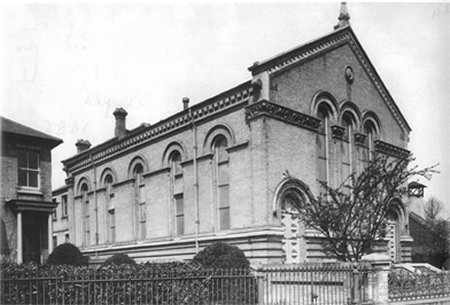
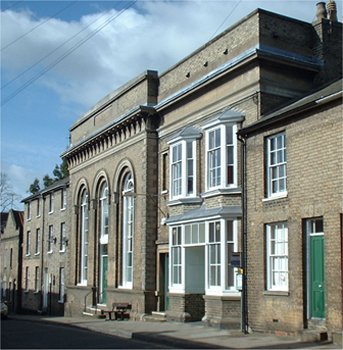
By 1929 the number of Roman Catholics in the town had increased significantly. The dioceses responded by purchasing a former Public Lecture Hall and converting it into St Thomas of Canterbury Roman Catholic Church.
The former Public Lecture Hall which, in 1929, was converted into St Thomas Roman Catholic Church.
Articles on the two Convents in Woodbridge
Introduction
Catholic services were held in Woodbridge in 1812 and 1815, but the number of Catholics amongst the local population was small. The services were conducted by Abbe Simon one of the French clergy who fled the anti-clerical regime of the French Revolution. From 1793 he was Chaplin to the barracks on Rushmere Heath. There is a local tradition that Abbe Simon was stoned by some inhabitants when he came to Woodbridge. Certainly the town was anti-Catholic. The bells of St. Mary Woodbridge, were pealed in protest when the Catholic Emancipation Act was passed in 1829. It removed discrimination against Roman Catholic teachers and schools.
In 1872 a Catholic Church was built in Crown Place, as a result of a donation by a priest in Ipswich, but the small number of Catholics in Woodbridge found it hard to raise enough money for the upkeep of of the church and to pay for a resident priest. Sometimes they had to resort to paying for a priest to come from Woodbridge.
The eventual resurgence of Roman Catholicism in Woodbridge was due to Father William Cooper who came to the town in 1919, on his retirement from his ministry at Felixstowe. Two years later he persuaded the Carmelite nuns from Notting Hill, London, to found a convent in Woodbridge by giving then his house in Church Street. Father Cooper was also instrumental in persuading the Sisters of Mercy to found the Convent of Our Lourdes, and the Covent School of St Philomena, in Woodbridge.
Carmelite Convent on Church Street
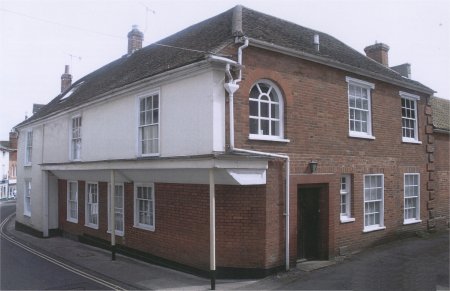
In 1921 Father William Cooper persuaded the the Carmelite nuns from Notting Hill, London, to found a convent in Woodbridge by giving then his house in Church Street. The nuns subsequently financed the chaplaincy that enabled a resident priest to be appointed for the parish. The community grew rapidly to about 25 members and in 1927 they bought properties in Church Street on either side of the original house.
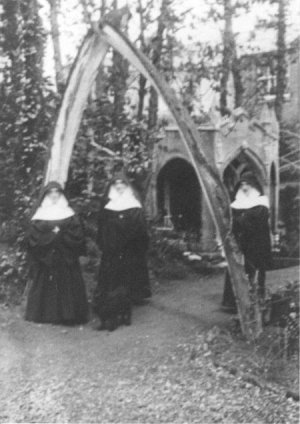
The nuns had a rigorous regime of worship, prayer and work. Only two of them were allowed to venture into the outside world, but there was a parlour where visitors, who came to ask for advice or for a prayer to be said, could talk to the nuns through a grill. Messages and goods for the convent were put into a ‘turn’, a revolving cylinder fixed into the wall. The cylinder was then rotated so that its contents could be taken out inside the convent. Some say that this is where the name Turn Lane comes from but they are wrong. The name Turn Lane dates back to at least 1765.
By 1938 the premises in Church Street had become too cramped and noisy for the nuns, and they moved to Rushmere. Then, in 1948, they moved to Quidenham near Attleborough in Norfolk, where the community remains. The Church Street buildings were used by the military during the war, and afterwards it was sold the the Culmark brush company. In 1982 a residential development was built on part of the site and was given the name Carmelite Place.