Home > Street and River Photography > Seckford Street
Seckford Street
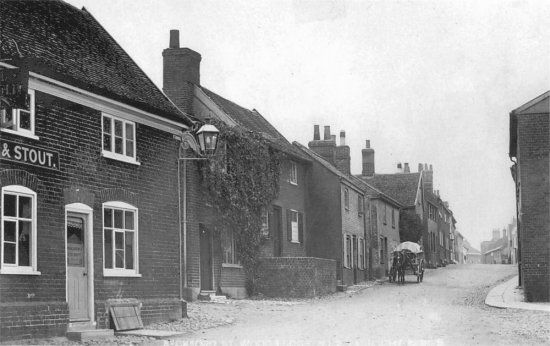
According to a survey of the manor of Woodbridge late Priory in 1560, Seckford Street was then called Le Fishpond Street. The pasture to the south of the street was named “Le Fishponds” because it contained the fishponds of the Augustan Priory which, until 1542, had stood near St Mary’s Church.
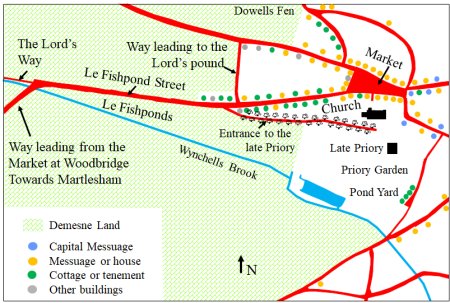
The map on the right shows the other features mentioned in the survey overlaid on the road layout from the 1881 OS map. The shaded green area was agricultural land which was part of the demesne of the manor. This land had formerly been retained by the lord of the manor but, by 1560, it was divided up into plots of various sizes which were rented out. The coloured dots mark the approximate locations of the 23 dwelling mentioned in the survey. Some of these dwellings were rented to more than one tenant.
“The entrance to the late priory” ran behind the houses on the southern side of Le Fishpond Street. All that remains of this entrance is a path, now called Monks Walk, lined by an avenue of trees. Below the area where the Priory had stood there were two plots of land described as “the garden of the priory” and “the pond yard”. An 1827 map only shows one fish pond along Wynchell’s Brook but there may have been others which have subsequently been filled up.
About a third of the way along Le Fishpond Street there was a junction with “the way leading to the Lord’s pen”. This pen, a pound where stray animals were held, was midway along the lane which was later called Pound Lane.
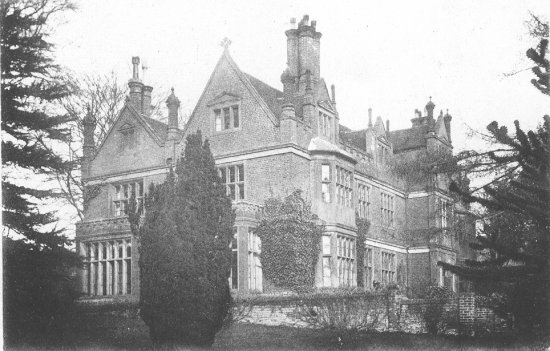
Thomas Seckford purchased the manor of Woodbridge late Priory in 1560. Shortly after he built the house called ‘The Abbey’ on or near the site of the former priory and created “an enclosed park”. Access to the Abbey was via an entrance at the top of Church Street.
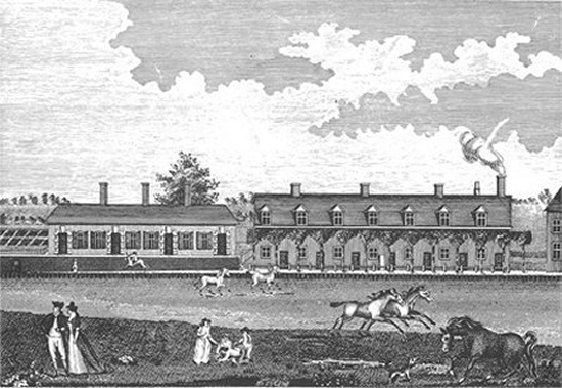
In 1575 he obtained a licence from the Queen to found almshouses for the constant residence of thirteen poor men. They were to be accommodated in seven tenements he had just built on northern side of Le Fishpond Street. Seckford ordained that the 13 almsmen would have use of a nearby garden of about 3 acres and of a fountain or well in his “newly enclosed park in Woodbridge”. It is probably because of the fountain or well that Le Fishpond Street was being called Well Street by 1587
In 1577 a free school for boys was established by Thomas Arnott on what is now Theatre Street.
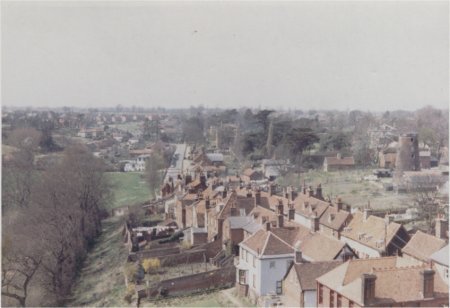
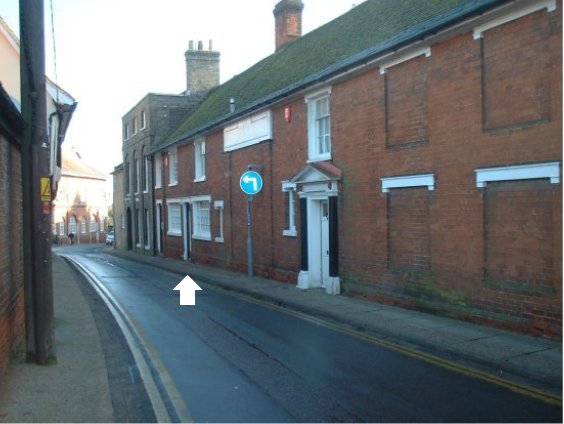
The school had to close in 1647 because of legal action over the terms his will. The loss of the school was a serious blow to the town so, in 1662, three local people decided to create the Woodbridge Grammar School in a house on Well Street (Seckford Street) which abutted the north end of the churchyard. The white arrow, on the photograph to the right, marks the location of the house.
When the number of scholars increased the house was found to be too small, and it was enlarged in 1665, 1670 and 1694 by public subscription. The schools flourished during the period 1796 to 1814 when it attracted pupils from the families of the officers stationed in garrison near the town but it then when into decline after the departure of the troops in 1814.
In 1861 ailing grammar school was amalgamated with the the almshouses and hospital. They were administered by a single charity which eventually became the Seckford Foundation. Soon after the school was moved to its present site off Burkitt Road and was expanded. Although the school took up most of the available funds the Foundation was also able to improve conditions for the poor in the town.
Although the school took up most of the available funds the Foundation was also able to improve conditions for the poor in the town. To that end the Seckford Foundation opened a dispensary in a room at the Hospital. It provided “medical advice and medicines to the residents of the Hospital and Almshouses and to those inhabitants of the town and neighbourhood who could not afford to pay for treatment – but only if they were not receiving support from the parish”. The Dispensary was also available to those who were nominated by “subscribers” This facility was used by some employers to provide medical treatment for their employees. The cost for each person nominated was 10s 6d per annum.
In the early 20th century the Lower Fen and the Upper Fen, which were collectively known as Fen Meadow, were given to the town for use as a recreation area.
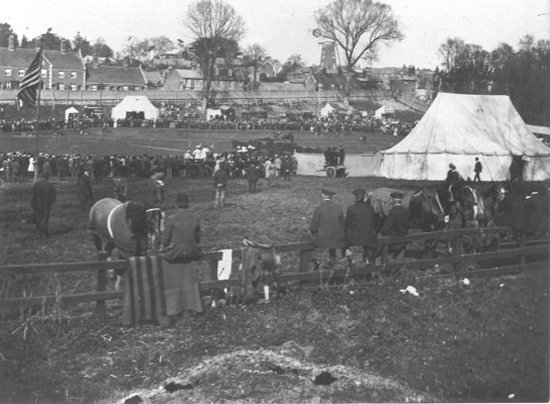
A condition of the gift, made by Mr E G Prettyman, was that the annual Horse Show should continue to be held on Fen Meadow. This Horse Show, reputed to have been one of the oldest in the country, had originally been held on the Crown Meadows (by Quay Street) as part of the Lady Day Fair.
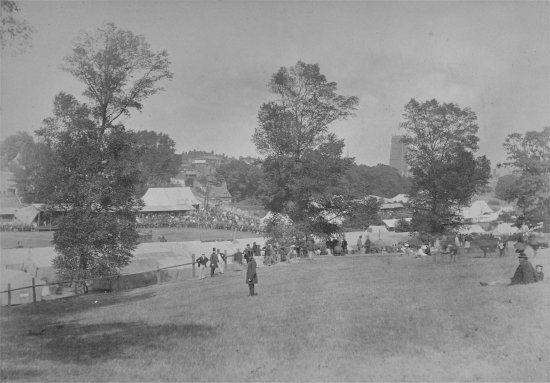
This photograph of the Suffolk Show was taken in 1865.
When the show was moved to Fen Meadow fencing was erected along the side of the Seckford Street to prevent people seeing the show without paying.
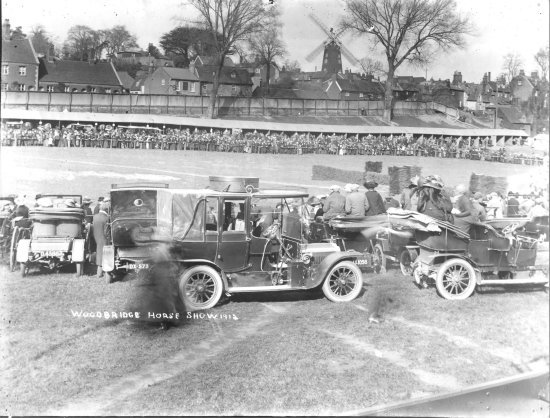
This photograph is of the Horse Show in 1913.
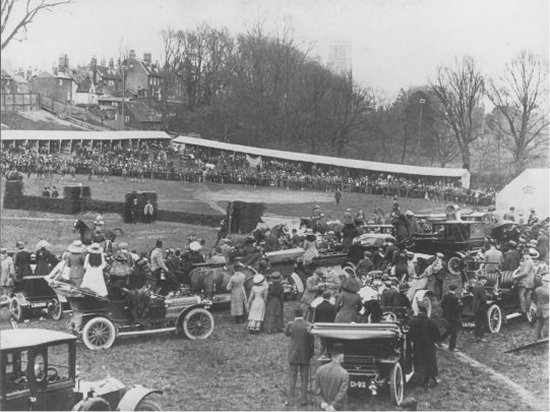
This photograph of the Horse Show was taken in 1920.
The 6.8 acre field was also used as a sports ground and by 1950 there was a concrete cricket pitch and a cycle track there. Due to problems with drainage the sports ground was moved to Kingston Field which had been bequeathed to the town in the late 1940s.
In 1575 Thomas Seckford obtained a licence from the Queen to found almshouses for the constant residence of thirteen poor men. They were to be accommodated in seven tenements he had just built on northern side of Le Fishpond Street. Seckford ordained that the 13 almsmen would have use of a nearby garden of about 3 acres and of a fountain or well in his “newly enclosed park in Woodbridge”. It is probably because of the fountain or well that Le Fishpond Street was being called Well Street by 1587.
Following a fire the almshouses were rebuilt in 1733. Fifteen years later the nurses’ residence was built alongside the almshouses because the old one proved to be inconveniently situated and needed repair.
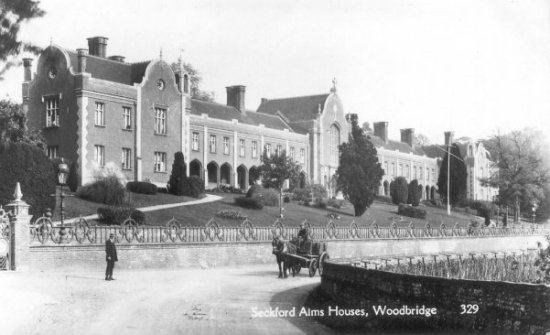
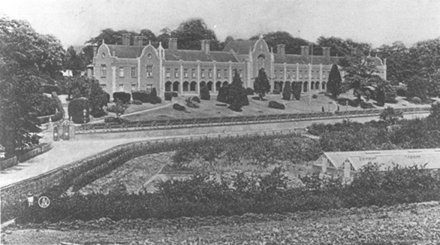
Seckford had endowed his almshouses with land in Clerkenwell (London) and, by 1832, the accumulated income from this property had greatly increased. This enabled the governors of the almshouses to double the number of almsmen. For their reception they commissioned the erection of a large and handsome Hospital with 32 bed-sitting rooms, each with a kitchen and a bath. Construction of the east wing started in 1834 and by 1839 the residents of the old Almshouses had moved in. Three years later the western wing and a lodge (for a porter/gardener) were completed and the massive gates and railings erected. The total cost of the new complex was about £28,000. The chapel between the east and west wings was competed in 1843 at accost of £1200. There was seating accommodation for 150 to 200.
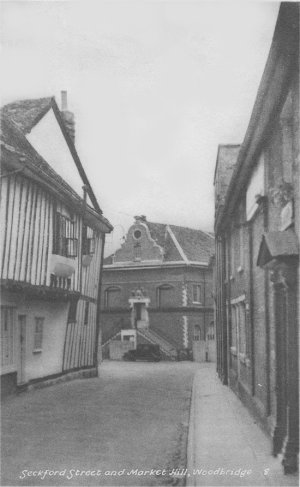
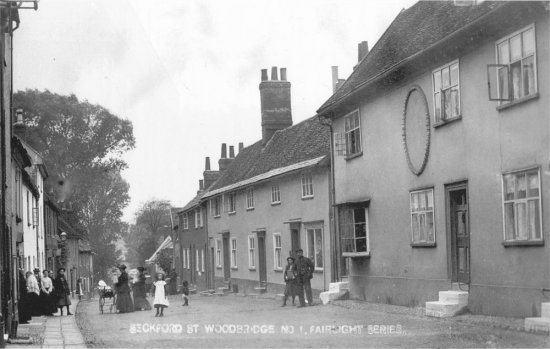
By 1840 the name Well Street was changed to Seckford Street presumably because it was dominated by the Seckford Hospital.
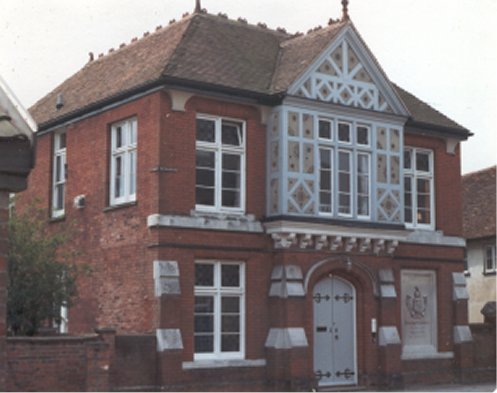
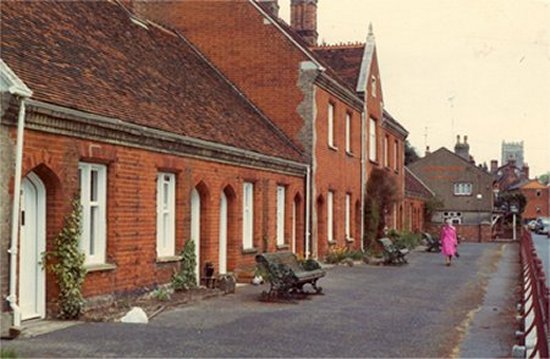
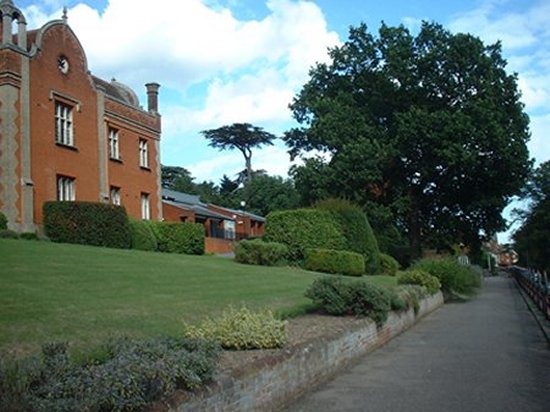
In 1869 the old almshouses, and the adjacent nurses’ home, were demolished and the this two story building opposite Fen Meadow was erected. They provided accommodation for eight married couples, eight single women and a nurse.
From 1908 until 1975 the Hospital had to manage on a fixed income from the assets held by the School. This income was increased from £2,000 in 1908, to £3,000 in 1957 and to £4,000 in 1967. During this period the number of residents remained constant.
In 1975 the Seckford Charity announced its intention to provide “a care unit and ancillary services” to increase the charity’s contribution to the community of Woodbridge. A sum of £150,000 was set aside for this purpose. The proposed care unit, Jubilee House, was occupied in June 1978. It was designed to house the more physically frail residents and to provide a social centre for the whole Seckford Hospital complex. Jubilee House also provides a limited Day Centre for other residents of Woodbridge.
In April 1980 an offer of £825,000 was accepted for nearly all the remaining Clerkenwell properties. An investment portfolio was created to sustain the Seckford Charity in the years ahead. By 1987 the value of the investment portfolio stood at £5,000,000. The properties owned by the charity were insured for replacement purposes at a combined value of £20,000,000.
In 2005 a major refurbishment of the Seckford Almshouses was started to bring accommodation up to modern standards and make it suitable for wheelchair users. This work has not changed the exterior of the almshouses.
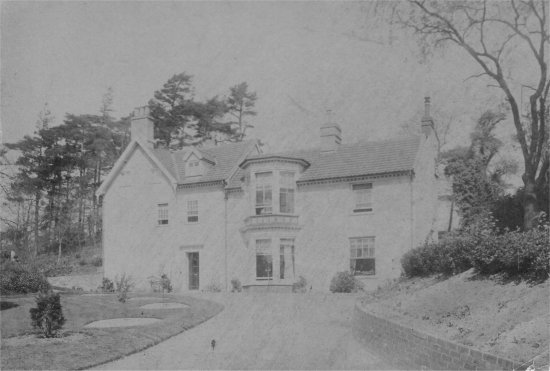
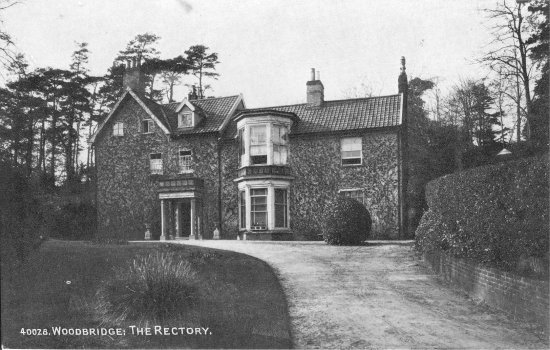
Sometime around 1831 a ‘mansion’ was built by the junction of Well Street and Collett’s Walk to serve as the rectory of St Mary’s Church.
In 1984 number 9 Church Street, which had previously been part of the Carmelite Convent, was refurbished and it replaced the old Rectory on Seckford Street.
The former Rectory became a private residence.
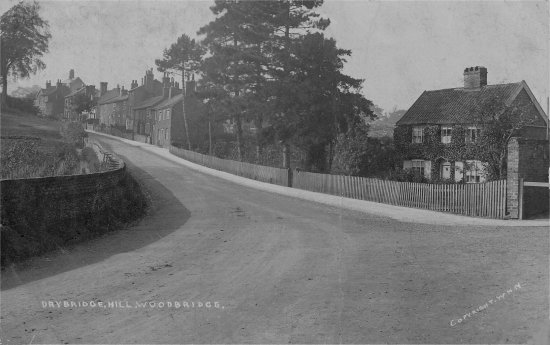
Dry Bridge Hill