Home > The Story of Woodbridge > Benefactor of the Aged and the Poor
Thomas Seckford - Benefactor of the Aged and the Poor
Throughout the Middle Ages men of fortune followed the customary practice of leaving from a third to a half of their movable goods to endow an institution of permanent value to the community. Such benefactions appealed to the constructive and practical outlook of many of the wealthier merchants and tradesmen. Sometimes schools or public granaries were founded but almshouses for the aged poor were much more popular.
Of all the bequests made by Woodbridge people to benefit the poor, it is the one by Thomas Seckford in 1587 which had the greatest impact at the time. Moreover, it eventually led to the creation of the Seckford Foundation which continues to a play a major role in the life of the town today.
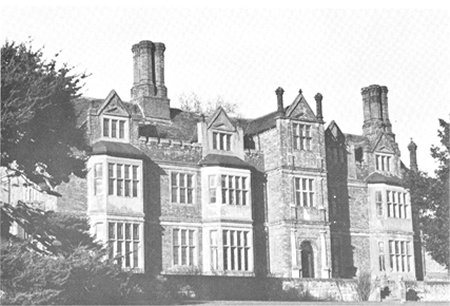
Thomas Seckford, who was born in 1515 at Seckford Hall near Woodbridge, became an eminent lawyer and was one of the two masters of the Court of Requests. The function of this court was to “hear and settle poor men’s complaints with as little cost as possible and to exercise compassion as far as this was compatible with speed and justice.” Complaints were presented in the form of petitions to the Queen as she moved around the country and one of the two Masters of the Court of Requests always travelled with her. Thomas Seckford had a large house and estate in Clerkenwell (London) and another in Ipswich where he was MP for a number of years. In 1564 he purchased the manor of Woodbridge late Priory from Elizabeth I and built his third house, which he named The Abbey, on the site of the former Priory.
Thomas Seckford’s Bequest
Seckford died in 1588 and, during that year, he obtained a licence from Elizabeth I to found an “almshouse, based on seven tenements which he had recently built in Woodbridge, for the constant residence of thirteen poor men”. Seckford ordained that the 13 almsmen should have a yearly supply of fuel and gowns and an annual stipend. They were also to have use of the gardens, of about 3 acres of land near the almshouses, and of the well and fountain in his newly enclosed park around The Abbey.
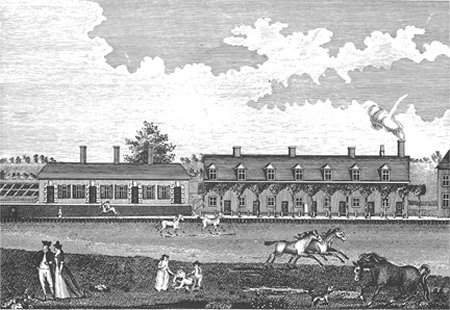
The Almshouses consisted of “seven rooms of brick and stone, and a garret in every one of them”. One of the almsmen, called the “Principal poor man” was held responsible for the good behaviour and discipline of the others. The Principal poor man had a room to himself, but the other almsmen had to share two to a room. Each of these rooms was attached to a piece of garden. The annual stipend was £5 (£6 13s 6d for the Principal).
Thomas Seckford also ordained that the tenement called Copthall, and 2 acres of land, should be used for 3 poor widows to act as nurses to any of the poor men who should happen to be sick or infirm. The annual stipend of these nurses was £2 13s 4d.
Seckford died within months of his almshouses being licensed by Queen Elizabeth and in his will the almshouses were endowed with various houses, buildings, yards and gardens in the parish of St James, Clerkenwell. The rents from these properties yielded £112 per annum. This provided the £94 needed to cover the pensions, gowns and wood for the poor almsmen. From the residue Seckford wanted payments to be made to the poor of Clerkenwell and of Woodbridge and to Christ’s Hospital, Ipswich.
The size of Seckford’s bequest was not extraordinary by Elizabethan standards but the land in Clerkenwell, with which he endowed his almshouses, became much more valuable as London grew. The rents received for this land soon became far more than was needed by the almshouses and the residue was allowed to accumulate for over two centuries. It was this accumulated revenue which was to have a significant impact, during the nineteenth century, on both the care of the elderly and on education in Woodbridge.
Seckford’s wife died the year before he made his bequest and, as there were no children, he specified that the affairs of the almshouse were to be managed by two governors, the Chief Justice of the Court of Common Pleas and the Lord of the Manor of Seckford Hall. In the event that the male line of Seckfords failed, the other governor was to be the Master of the Rolls. It was just as well that Seckford made this provision because the male line ended in 1683.
The Revenue From Clerkenwell Increases
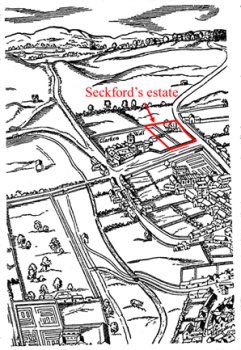
By 1767 the Clerkenwell was highly developed and Seckford’s estate was leased (for 60 years) in 6 parts. They produced an annual income of £565. In that year the bequest to the poor of Clerkenwell (at Christmas) was increased from £2 to £10. Almshouse expenditure was;- the Principal poor man £27, twelve poor men £20 each, three nurses £12 each, the Minister £10 and the two Church Wardens £5. The surplus income was accrued for future repairs. These reserves were substantially boosted, in 1823, when a portion of the Clerkenwell estate was sold for £39,456 to the Middlesex magistrates for a new prison. The following year the Woodbridge Almshouses were ‘new-fronted in a neat and appropriate style’ at a cost of £1,470.
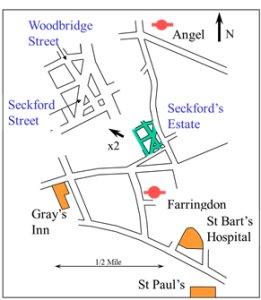
An Act of Parliament obtained in 1826 enabled the Governors to make major changes to the Clerkenwell estate. They were able to demolish or alter buildings, to erect new ones and change the road layout. By 1830 over £20,000 had been spent transforming the area. A distillery, a factory, a chapel, a public house, a school and a number of terraced houses had been constructed. As a result of the changes the annual rental revenue increased to over £3,000.
Map showing the Clerkenwell Estate today.
Expansion of the Seckford Almshouses in 1832
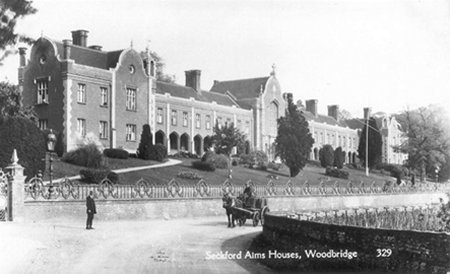
By 1832 the accumulated reserves had so greatly increased that the Governors determined to double the number of almsmen. For their reception they commenced the erection of a large and handsome Hospital with 32 bed-sitting rooms, each with a kitchen and a bathroom. Construction of the east wing started in 1834 and by 1839 the residents of the old Almshouses were moved in to it. By 1842 the western wing and a lodge (for a porter/gardener) were completed and the massive gates and railings erected. The total cost of the new complex was about £28,000. The chapel between the two wings was completed in 1843 at a cost of £1200. There was seating accommodation for 150 to 200.
During the years following the expansion of the Almshouses there was considerable debate within the town on how to use the remaining money which had been accruing from the Clerkenwell estate. Some wanted it to be used to help the poor of the town but others suggested that it should be used to support the, then ailing, Woodbridge Grammar School. This had been founded in 1662 by three local people one of whom was Dorothy Seckford, the last of the Seckford family.
The Seckford Hospital circa 1900.
Amalgamation of the Seckford Charity with that of Woodbridge Grammar School
The churchwardens, as Trustees of the Woodbridge Grammar School and as local representatives of the Governors of the Seckford Charity, recommended a compromise solution. They proposed amalgamating the Seckford Charity with that of the Grammar School while at the same time expanding the services to the poor of the town. This recommendation formed the basis of a scheme for the management and regulation of the amalgamated charities which was drawn up by the Attorney-General and then approved by the High Court of Chancery in June 1861.
In a statement explaining the reasons for supporting the amalgamation of the charities, the High Court of Chancery noted that using the surplus funds for indiscriminate poor relief could result in “pauperising the town of Woodbridge” . This was a view which was in accord with the actions of the then infant Charity Commission which regularly criticised trusts that had been established to give grants to the poor of a particular place. Though some were well managed, most made little effort to ensure that grants were only given to those who had scant prospect of finding employment.
The 1861 scheme allowed for an expansion of the services offered to the poor of Woodbridge by (i) refurbishing or rebuilding the old almshouse (ii) providing a dispensary, lending library and public pump and drinking fountain (iii) making annual payments to the elementary schools in Woodbridge and giving grants towards apprenticeships for children educated in these schools. The remaining income of the charity could be spent on the Grammar School and a sum of up to £3,500 from the accumulated funds of the charity could be spent on a new building for the school. The Scheme also specified that the number of children of the deserving poor who would be offered free places was to be increased from 10 to 20.
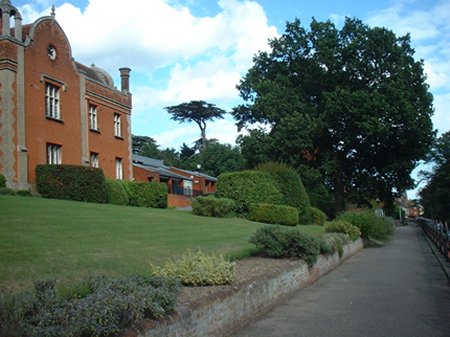
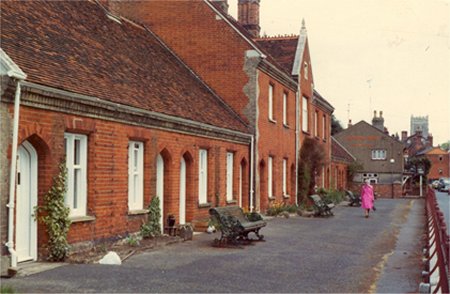
In 1869 the old almshouses, and the adjacent nurses’ home, were demolished and the present two story building opposite Fen Meadow was erected. They provided accommodation for eight married couples, eight single women and a nurse.
The new almshouses erected in 1869.
The Dispensary
Soon after the 1861 scheme was approved a dispensary was opened in a room at the Hospital. It provided “medical advice and medicines to the residents of the Hospital and Almshouses and to those inhabitants of the town and neighbourhood who could not afford to pay for treatment – but only if they were not receiving support from the parish” The Dispensary was also available to those who were nominated by “subscribers” This facility was used by some employers to provide medical treatment for their employees. The cost for each person nominated was 10s 6d per annum.
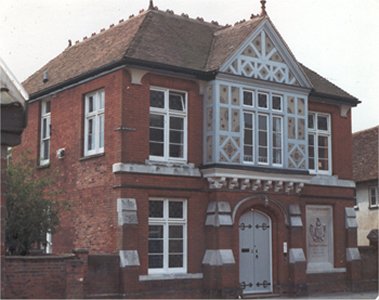
In 1876 the Dispensary was moved into the house in Seckford Street which had previously been occupied by the Free Grammar School. Finally, in 1886, a vacant plot adjacent to this house was used for a custom built Dispensary (erected at a cost of £1500). There were two wards named Victoria – after the Queen – and Dorothy – after the last of the Seckfords.
The Dispensary continued to provide medical services to the poor of Woodbridge and the neighbouring parishes until the introduction of the National Health Service in 1948. It was then used as the HQ of the Woodbridge Red Cross until 1974 and it has since been converted to private flats.
The Dispensary built on Seckford Street in 1886.
The Lending Library and the Public Pump and Drinking Fountain
The Seckford Lending Library started as a few volumes occupying some shelves in the shop of a hairdresser on Market Hill. (This shop was demolished, in 1884, to create what is now the memorial garden.) In 1869 the Library was moved to a house on St John’s Hill. Six years later £500 was spent on fitting out part of the former Grammar School on Seckford Street as a library. In 1900 the Charity was allowing the Library committee to spend £50 per annum on new books and they were “at much pains to exclude all novels of a merely sensational character or of any approaching to an immoral tendency”.
The rooms above the Library were eventually used as a reading room and as committee and games rooms by members of the “Seckford Reading Room and Social Club”. This had a wide membership and the subscriptions for members ranged from 4s per annum for individuals to 10s 6d for families. By 1951 the Seckford Library was also a branch of the East Suffolk County Council and the Seckford library was the reference section. The reference section closed in April 1963 and the library moved to a new site in Oak Lane in July 1970.
The public pump and drinking fountain, or both, “for the use and convenience of the poor inhabitants of the town and neighbourhood” was erected on the Market Hill in 1877. Its design was based on the hats worn by Queen Victoria. The fountain had “a trough continually filled with water, for the comfort and convenience of dogs, horses and cattle passing through the town”.
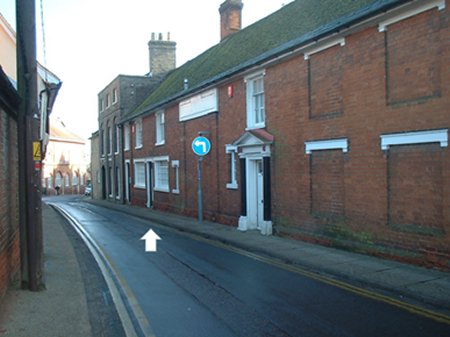
From 1869 to 1970 the library was in part of the building on Seckford Street which had formerly been used by the Woodbridge Grammar School.
The Seckford Hospital Post 1908
From 1908 until 1975 the Hospital had to manage on a fixed income from the assets held by the School. This income was increased from £2,000 in 1908, to £3,000 in 1957 and to £4,000 in 1967. During this period the number of residents remained constant.
In 1975 the Seckford Charity announced its intention to provide “a care unit and ancillary services” to increase the charity’s contribution to the community of Woodbridge. A sum of £150,000 was set aside for this purpose. The proposed care unit, Jubilee House, was occupied in June 1978. It was designed to house the more physically frail residents and to provide a social centre for the whole Seckford Hospital complex. Jubilee House also provides a limited Day Centre for other residents of Woodbridge.
In April 1980 an offer of £825,000 was accepted for nearly all the remaining Clerkenwell properties. An investment portfolio was created to sustain the Seckford Charity in the years ahead. By 1987 the value of the investment portfolio stood at £5,000,000. The properties owned by the charity were insured for replacement purposes at a combined value of £20,000,000.
In 2005 a major refurbishment of the Seckford Almshouses was started to bring accommodation up to modern standards and make it suitable for wheelchair users. This work has not changed the exterior of the almshouses.