Home > The Story of Woodbridge > The Second World War
Woodbridge During the Second World War
During the Second World War regiments, including the Liverpool Scottish and the Beds and Herts, occupied some of the larger houses in and around Woodbridge. The Suffolk War Agricultural Committee also had an office at Fern Hill House in the adjoining parish of Melton.
An Officers Commando Army Training School was established across the River on the other side of the estuary Sutton side and soldiers, during their off duty hours, used the services of the ferry to visit the Woodbridge Inns. Those who wished to remain sober could visit the ‘service canteens’, run by members of the churches and chapels, where “a very welcome ‘cuppa’ and homemade cakes could be obtained, for a few pence, and a game of ping-pong played”
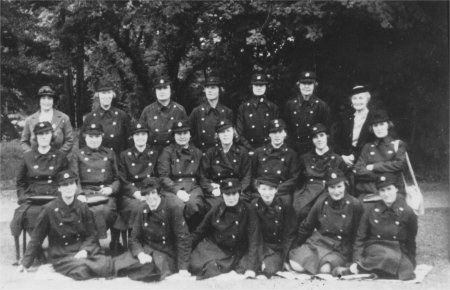
Woodbridge was not bombed during the War but crashed aircraft, both friendly and alien, were quite numerous in the area. The Woodbridge Red Cross Detachments established a First Aid Post in a building behind the Crown Hotel. It was manned every night but never put to the test. The Red Cross Detachments were, however, called upon to help casualties when other towns in the area were bombed.
The Air Raid Precaution Service and the Home Guard
The Air Raid Precaution (ARP) Service was set up in 1938 and it recruited air raid wardens, auxiliary firemen, special constables, gas decontamination squads, first-aid parties, rescue parties, etc. By September 1939, 1 million men and women had been enrolled. They were backed up by other organisations, such as the Red Cross Voluntary Aid Detachment and the Women’s Voluntary Services, who operated mobile canteens and cared for evacuees and bombed-out people.
The Woodbridge ARP Service had a post in the former maltings behind the Crown Hotel. They were called out to assist when Wickham Market and Aldeburgh were bombed and when there were air crashes in the Woodbridge Area.
The Home Guard was formed when invasion threatened two weeks before Dunkirk. A few of the men in the Home Guard were issued with Sten guns but the rest had 12 bores. All wore uniforms, carried a spy-light pack and ammunition pouches. They kept their ammunition at home when not on duty.
The Woodbridge Home Guard was recruited at the Army Drill Hall, Station Road, which had built been in 1920 for the Territorial Army. The recruits were under orders to blow up Wilford Bridge should an invasion occur. At first all of them rushed to the bridge every time a siren went off. Later five members of the Home Guard were permanently on duty at the bridge and they called on reserves as needed. Every member had four nights a week when they had to sleep at the Headquarters at Ivy Lodge, Cumberland Street. They took it in turn to keep awake next to the telephone. Officers from the regular army (at Bury St Edmunds) were in charge.
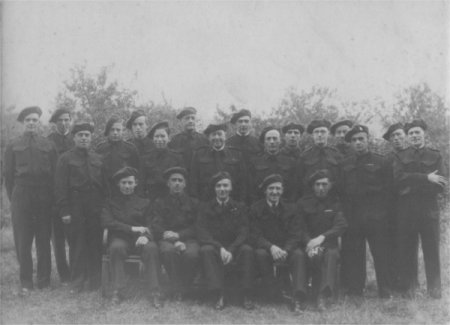
Reminiscences and images relating to the Home Guard
Anonymous
Regiments like the Liverpool Scottish, the Beds and Herts, occupied some of the larger houses in and around Woodbridge. Seckford Hall was requisitioned for use by an Ack Ack unit. The guns were so positioned on high ground at Seckford Hall, one assumed to fire at any would be raider of the Luftwaffe, seeking out the Royal Air Force Station at Martlesham Heath. In addition to there being troops stationed in Woodbridge itself, various units were dispersed around the town in adjoining villages, the Royal Tank Regiment at Clevering Hall and park to mention but one.
Woodbridge used to benefit from an influx of these troops from time to time, swelling the already crowded public houses, eager to sample the local ‘brew’. The local Cinema became very popular with troops and civilians alike, with all the latest American films on offer, providing a welcome relief from the weary day to day drudge of the War.
An Officers Commando Army Training School was established across the River on the Sutton side, and on their off duty hours used to use the services of the ferry to visit the Woodbridge Inns. Many a soldier has taken a ducking falling from the Ferry boat on the return journey having imbibed too much ale, much to the consternation of the ferryman, a Mr. Dick Elvin. On a more ‘sober’ note, however, most of the Church and Chapel members opened service ‘canteens’ in the evenings, where a very welcome ‘cuppa’ and homemade cakes could be obtained, for a few pence, and a game of ping-pong played.
As far as I can remember, Woodbridge did not receive a direct hit from a bomb, during the War. I witnessed from a safe distance, the bombing of Martlesham RAF station, by German Stuka dive bombers, on a sunny August afternoon, also a gigantic explosion one night from a land mine which landed at Bredfield, the blast from which pitched me out of bed, and shattered a window. I guess one could say that Woodbridge was lucky in that respect, although there were no actual military installations in the town which could have provided a target. Crashed aircraft were quite numerous in the Woodbridge area, both friendly and alien. An Italian Fiat bomber crashed at Tangham Forest, on its way to bomb Martlesham. An American Flying Fortress ditched in the Deben at Ramsholt, and many more.
George Cole's Account of the Home Guard
George Cole was an agricultural worker and a member of the Home Guard. He worked for Tile Brothers (vegetable merchants) at The Old Maltings in Station Road. He supervised the market gardening being done by women (sometimes as many as a hundred), the majority of whom were Land Army Girls.
Permits were needed for all lorries when they travelled past checkpoints placed on roads leading from the coast. There was a checkpoint near where the Sutton/Hollesley Roads converged.
The Home Guard was formed when invasion threatened two weeks before Dunkirk. The Prime Minister declared that he had 3 million recruits overnight. Locally recruitment was done in the Army Drill Hall, Station Road, opposite the Boat Inn. This hall was originally built in 1920 for the Territorial Army, B Company. Cadets used it later.
Officers from the regular army (Bury St Edmunds) were in charge of the Home Guard. Mr Cole had a Sten gun issued to him but most had 12 bore guns. All wore uniforms, carried a spy-light pack and ammunition pouches. They kept their ammunition at home when not on duty. Their orders where to blow up Wilford Bridge should an invasion occur. Training on how to do this was given, and because of this objective, Wilford Bridge was also the collection point for the regiment.
In the early days every time a siren went all the Home Guards rushed to the Bridge. Later a system was worked out that five Home guards were permanently on duty and they called on reserves as needed. Every recruit had four nights a week when they had to sleep at the Headquarters at Ivy Lodge, Cumberland Street. They took it in turn to keep awake next to the telephone.
A Spigot mortar (anti-tank) guarded Bromeswell Road from the 18th hole of the Golf Course. Ack Ack guns were in place at Melton Grange and at Seckford Hall.
The only incident that Mr Cole remembers was a 15 bombs being dropped in the river during a German attack on mock landing craft.
Agricultural workers were given a double cheese ration and they supplemented their diet with rabbit meat.
A London couple were billeted on the young Cole family. They stayed, in their house on Edwin Avenue, for the entire war.
A Declaration of Peace was made from the steps of the Shire Hall. Edwin Avenue held a street party to celebrate
Extracts From an Account by Anne Silvers
With a very real possibility of a German invasion, various defences were set up across the country. These included concrete blockhouses (or pillboxes) at strategic points. To fool the invaders these were imaginatively (and naively) disguised – the designers must have had a lot of fun! On the west side of the A12, opposite the xxx junction there was a big hoarding advertising ‘Hotel Endisnear – Continental Visitors Particularly Welcome’. Further south on the A12, our bike rides to Ipswich were cheered by a ‘Roadman’s hut’, with painted spades and a neat board saying ‘A. Mole, Deepdownham’. One proposed strategy in the event of an invasion was for our defence forces to lie low while the Germans moved forward, and then to harass them from the rear. To this end ‘secret’ underground bunkers were dug in selected places. One of these was just inside what was known as Arnie’s Wood off Doe’s Alley, a track running from the Bxxx at the Foxboro turn down to the xxxx in Melton. We knew about this bunker during its construction as the men digging it had borrowed our ladder to get in and out. Once it was occupied (I’m uncertain if this was by troops or the Home Guard) it was even less secret because in the evenings the inhabitants (and their local visitors) stood outside chatting, their voices audible and their cigarettes visible in the dark.
Despite wartime campaigns to discourage rumour mongers all sorts of misinformation flourished. One story, concerning a mother and son with a Germanic name, claimed that they signalled to German bombers by hanging out sheets. Just what they signalled was unclear. Later in the War there was pressure in some quarters for the Allies to open a ‘Second front’ to defend Russia from the Germans. I remember people withdrawing their custom from a shop whose owners supported the Second front and, as a result, were deemed to be Communists.
The Red Cross established a First Aid Post in a building in a lane behind the Crown Hotel. It was manned every night but never put to the test so far I know. I was under the impression that Woodbridge itself escaped any bombing despite its proximity to RAF and US airfields at Debach and Tunstall. Aldeburgh was certainly bombed though I am not sure how often.
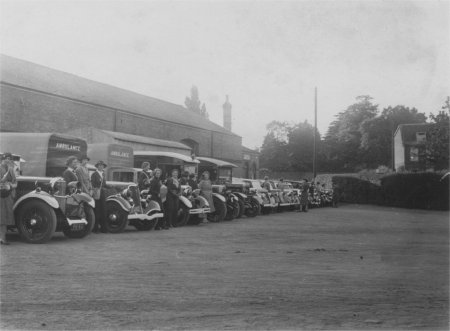
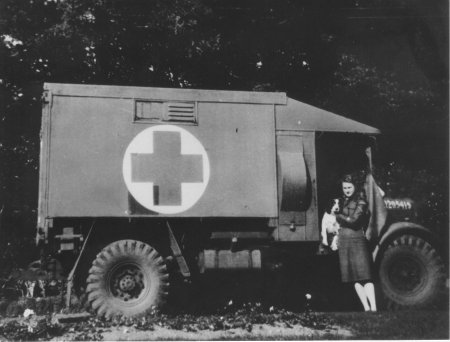
In the summer of 1942, I came home from my Boarding School and was given a message at Woodbridge Station telling me to walk home. My mother, who was in the Red Cross, had gone off in the ambulance with members of the Woodbridge Detachments (Suffolk 1 for men, and Suffolk 2 for women) to help with the casualties. I think it was on the journey to Aldeburgh that one of the women was irritated by a member of Suffolk 1 who claimed male superiority. As the ambulance was passing a Cemetery, she put him in his place with ‘There’s plenty in there as thought they were indispensable!’ My mother was usually on duty at the First Aid Post on Sunday nights. It was very difficult to get batteries for bike lights (which in any case had to be kept dim during the blackout) so we resorted to acetylene lamps. These gave a feeble glow, smelt horrid and frequently went out. When the First Aid Post was dismantled at the end of the war one of the helpers, a rather sheltered elderly lady, came across the urinals and said ‘I never realised we had these useful umbrella stands.’
Photographs Relating to the Home Guard
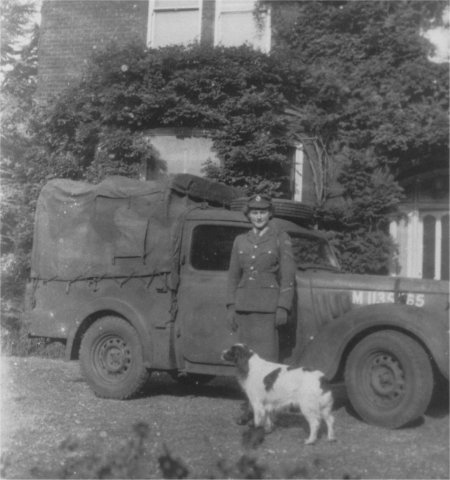
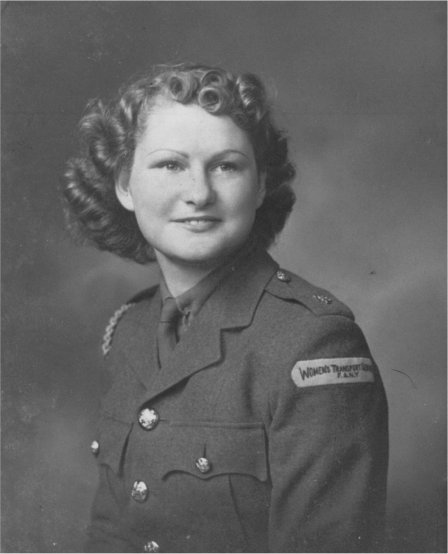
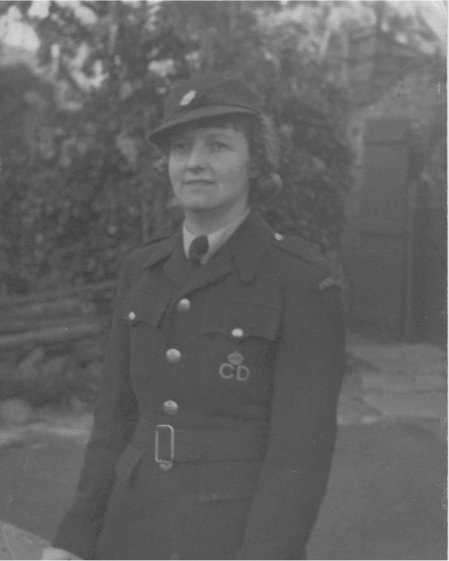
Ambulance Service.
The Women’s Land Army
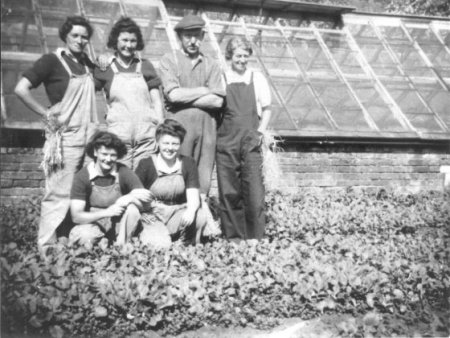
At times up to a hundred women, the majority of whom were with the Women’s Land Army, were involved in either market gardening or farming in the Woodbridge area. Some of them were volunteers and the remainder were called up. They could expect to do a wide range of agricultural work for a wage of 1 guinea a week (paid by the Suffolk War Agricultural Committee) and they had two paid holidays a year, at Christmas and Easter.
The ‘Land Girls’ came from all over the country. Some lived with the farmer’s family, and others in hostels under the care of a warden. There were hostels around Woodbridge at Little Manor Hasketon, Sutton Rectory, Sutton Hoo House and Grundisburgh Hall. The girls in the hostels were given a good breakfast and a packed lunch of two rounds of bread plus a piece of cake and a thermos flask for two. A lorry would pick them up at 7.30 in the morning and take them to their place of work. Lunch break was only half an hour.
At a time when conservation of all types of food was vital, Woodbridge Council offered one penny for each rat’s tail taken to their Offices and this gave children an opportunity to help the war effort. A Woodbridge resident recalls that, despite many other shortages, she and her 11 to 13 year old friends were able to get pellets for their airguns from shops in the town and that, every winter evening during the holidays, they would go with torches to farm buildings and stack-yard to shoot rats.
Some reminiscences of Land Army Girls
Agricultural work was hard. The Land Army Girls did hedging, sugar-beet singling, digging carrots, pitching corn and putting barley into stooks. After rain they had to re-stook to stop the barley becoming moulding.
If it was too frosty to work they had to stay in their hostels with nothing to do and no fire. At night when they stayed in they did knitting or embroidery. Other entertainments included playing records (Tea for Two was the favourite), going to the cinema, pubs, NAAFI and YMCA (for Table Tennis).
At work the recruits wore dungarees and a green jumper. They also had a walking out uniform with an armband which indicated the length of service and the type of work they did. A wheat sheaf badge on the armband signified that they worked on the land and a conifer badge that they were engaged in forestry.
Despite all the hard work, many former Land Girls have happy memories of the days in the Women’s Land Army.
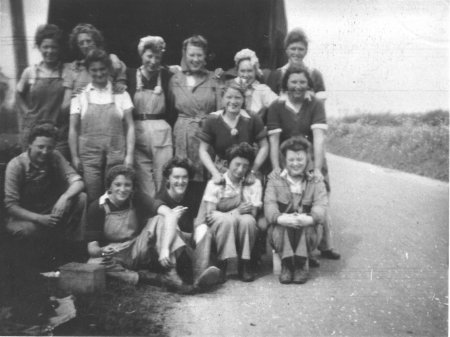
It was more fun in a hostel because there were other girls there and you were often working in a group.’
‘When hungry, which was often, you filled up on dried biscuits made of flour and water.’
‘At the hostel in Hasketon there were only two baths, one toilet and a sink for twenty girls – so a roster system had to be enforced. The warden this hostel was Miss Barrow. She made sure the girls were in by 10 at night and behaved themselves.’
One 7 stone girl tells of being was sent to work as dairymaid in at a farm in Stowupland where ‘the cows seemed enormous’. She also had to carry round the heavy galvanised pails. Her day started at 5.30 and she had to milk again in the afternoon. She did this for two year before being sent to a hostel at Hasketon.
‘Threshing was the worst job as you got red eyes and you were filthy when finished.’
‘The worst thing about agricultural work was that there were no toilets while you were out working.’
‘Being a land Army girl meant always being hungry, having sore blistery feet and a sore back. You were also either boiling hot or freezing cold.’
If you came back late or drunk after an evening out you were gated (prevented from going out) for several days.’
‘You could not buy cosmetics so Vaseline was used as a suntan lotion. Sometimes we put mud packs made of Fuller’s Earth on our faces. Potash was painted on legs to look like stockings and the seam was created by drawing a pencil line up the back of the legs.’
Raising Money to Help the War Effort
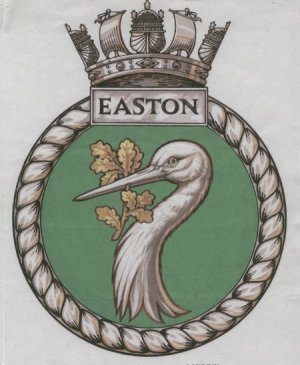
Each district was given a plaque, to commemorate the adoption of the warship for which they had raised money, and a number of copies of the ship’s crest. The plaque received by the Woodbridge and Deben district now hanging in the Shire Hall.
There was already a warship bearing a name that would have been more appropriate to the town. She was HMS Woodbridge Haven, a ‘Loch’ class frigate which had been built at Chatham dockyards.
Prior to raising money for HMS Easton the people of Woodbridge had raised money for the Spitfire Fund and for War Weapons Week.
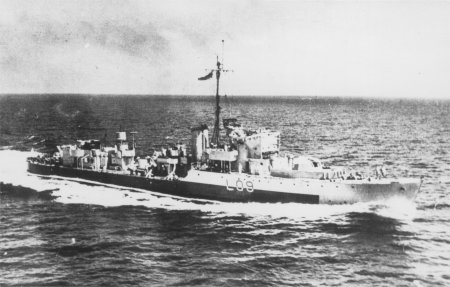
Details of HMS Easton (L09)
HMS Easton was a ‘Hunt’ class destroyer, a class that was designed to provide escort vessels for convoys. She was built by J S White & Co Ltd, Cowes on the Isle of Wight. She was ordered on 28th July 1940, laid down on 25th March 1941, launched on 11th July 1942 and completed on 7th December 42. Eleven days later HMS Easton rendezvous with the Armed Merchant Cruiser Canton and escorted her to the Clyde for defect repairs. HMS Easton was then allocated to the 22nd Destroyer Flotilla at Alexandria. To get there she took the place of the damaged HMS Badsworth in Convoy KMF 9, which sailed from the Clyde on 8 February 1943 and reached Algiers on the 16th.
HMS Easton was then used on general patrol and escort duties until August 1943. She was involved in the sinking of no less than four submarines during this period, three of them in a matter of 20 days. On 17th Feb 1943 with Wheatland, she sank the Italian submarine Asteria off Bougie, and six days later sank U443 off Algiers with Bicester, Lamerton and Wheatland. Subsequently U83 was damaged by Easton and then finished off by aircraft south of Cartagena on 9th March 1943.
On 22nd August 1943, while on escort duties covering the build-up after the Sicily Landings, HMS Easton sighted the U-boat U458 south of Pantellaria. HMS Easton rammed U458 at 20 knots and sank it but in doing so she considerably damaged herself as well.
After temporary repair at Malta, permanent repairs were not completed at Gibraltar until 18th Sep 1944. Easton then joined the 59th Destroyer Division, shelling Greek Communist positions near Piraeus between 5th and 9th December 1944.
In March 1945 it was decided that the Easton, amongst others, should be recalled to the UK in view of the U-boat situation in UK coastal waters. She joined the 21st Destroyer Flotilla at Sheerness in March 45 and after refitting at Southampton between May and August 45, she entered Category ‘B’ Reserve on 29th October 1945.
HMS Easton re-entered service with the 3rd Escort Flotilla at Portsmouth during 1946/7, but spent considerable periods under repair, finally being relegated to Category ‘B’ Reserve at Harwich on 3rd November 47. Easton transferred to Sheerness for a refit, which commenced on 8th August 49. However, work stopped on 2nd September 49 as Easton’s condition was so poor and on 4th November 49 she was allocated for service as a training hulk at Rosyth. She was stripped of equipment at Sheerness before transfer to Rosyth where she served as a hulk until 4th December 1952 when she was allocated to Metal Industries Ltd and scrapped at their yard at Rosyth in January 1953.
The Arrival of the Americans
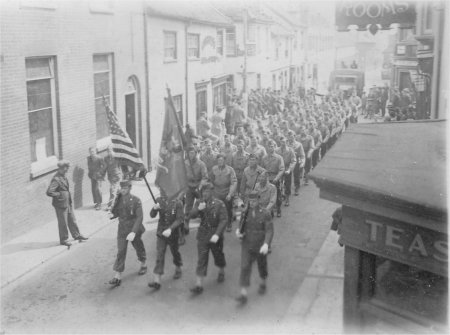
From the end of 1942 Woodbridge played host to the first batch of American servicemen who came to construct the Parham and Debach airfields. “The personnel were mainly coloured Americans which some of the locals found strange. They had never seen a real black skin, much less, one in a uniform. The American bases at Parham and Debach seemed to be completed and operational in a very short time and soon aircraft were leaving and arriving on their missions over Germany.” American servicemen were frequent visitors to Woodbridge and landlords of the various inns were hard put to keep pace with the demand. A resident recalls that “the main form of transport for our American allies, appeared to be bicycles, which they rode with gay abandon, mostly on the wrong side of the road”.
RAF Sutton Heath
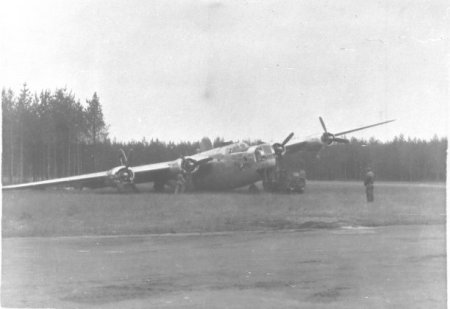
RAF Sutton Heath, which later became known as RAF Woodbridge, was completed in November 1943 as an emergency landing strip for damaged aircraft returning from operations over Europe. It had a single runway, about twice as long as the usual and of extra width, divided into three lanes so that aircraft could land in rapid succession. There was ample provision of rescue vehicles, with cranes and bulldozers to move wreckage out of the way as quickly as possible. There were two other emergency runways constructed on the east coast of England. The location was chosen because it was ‘nearly fog-free and had no obstructions for miles.
Within two months of opening the airfield it was realized that, despite the predictions, fog and low cloud was sometimes a problem in the area and it was necessary to install a fog dispersal system. Petrol injected under pressure into steel pipes running either side of the runway fed regularly spaced burners. The heat thereby generated was so intense that it lifted the fog to about 100 ft and thereby provided pilots sufficient visibility to land. The large amount of petrol needed by the system was delivered to Melton Station and was then pumped through a 4 mile long pipe into 350,000 gallon fuel tanks on the northeast of the runway. The Sutton Heath fog dispersal system was the largest of the 14 other systems installed around the country.
There were two other emergency runways constructed on the east coast of England. They were at Carnaby in Yorkshire and Manston in Kent.
By the end of 1944 a total of 2,719 damaged aircraft had landed there and this increased to 4,200 by the end of the war. The airfield also provided refuge to a German night fighter (a Ju 88) whose crew had lost their way. They were overpowered before they could remedy their mistake, and the aircraft was a valuable prize, complete with the latest enemy radar and confidential code books.
After the war name of the airfield was changed to RAF Woodbridge. It was used for mainly experimental work until March 1948 when it was considered to be surplus to requirements and was placed under care and maintenance. Then in June 1952 it was taken over by the United States Air Force who had taken control of RAF Bentwaters in March 1951. Although most of the service men and their families lived on the bases there some also lived in a housing estate just outside Woodbridge in the neighbouring parish of Melton.
Until the USAF relinquished these airfields in 1993 they would be known as the ‘twin bases’.
RAF Bentwaters and the Twin Bases.
RAF Bentwaters
RAF Bentwaters was the last of the five hundred RAF fighter stations built during the war. It was constructed in 1944 as a base for the USAF and took its name from that of some cottages in Rendlesham which were demolished in the process. By the time it was complete it no longer required by the USAF and in Nov 1944 it was taken over by RAF Fighter command and became the last RAF airfield to be activated during the Second World War.
The first RAF squadrons to be stationed there flew Mustangs, American fighter aircraft supplied under lend lease arrangements. With their long range, the Bentwaters fighters were able to escort RAF bombers on daylight operations as the land war in Western Europe moved towards and into Nazi Germany. Piston-engined Mustangs from Bentwaters scored the RAF’s first victories over the Luftwaffe’s jet fighter, the Messerschmitt Me262, and the rocket-propelled ME 163.
After the war the RAF used Bentwaters airfield for flying training on the Hawker Tempest Mk V and then the Gloster Meteor the RAF’s first jet fighter but in July 1950 flying operations ceased. Seven months later control of the base was handed over to the USAF.
The Twin Bases
The USAF operated out of the twin bases until 1993 and for most of the time they were home to one of the USAF’s most active and premier flying organizations, the 81st Tactical Fighter Wing. From its arrival in England, the 81st was always an important front-line unit in NATO. At its peak in the 1980’s the Wing was the largest in the free world, with some 130 aircraft in six fighter squadrons flying from its two bases in England and four Forward Operating Locations in Germany.
The Wing flew many different aircraft from the twin bases. They include the deafening Phantoms and finally the A-10A tank buster which sounded like a bee. They were all supported by a vast array of ground-based personnel, providing everything from aircraft maintenance and logistical support to civil engineering and recreational activities. The personnel were military and civilian, American and British. Most of the Americans lived on the bases but there were some who choose to live in the surrounding towns and villages.
In 1966 a private company built 150 houses at Bury Hill, Melton, for the American servicemen and their families. The estate was leased to USAF but when the lease came up for renewal in 1977 terms could not be agreed and the properties were offered for sale in January 1978.
When the Americans arrived the bases were little more than a neglected collection of corrugated-metal Nissen huts. When they left state-of-the-art military airfields, complete not only with advanced military buildings and facilities, but also with an entire American community to include roads, housing, shopping, schools and recreational facilities.
The twin bases were handed back to the MOD who sold the Bentwaters site to Seabrook Holdings. A proposal to use the airfield for commercial cargo floundered as a well organised public protest and the property was spilt into two and resold. The air field and the associated buildings are now known as Bentwaters Park and the domestic site on the other side of the A1152 is known as Rendlesham Park.
The airfield buildings on Bentwaters Park are leased to various small companies and the airfield pavements and runways are occasionally used for special events. Many of the communal buildings on the domestic site have been demolished and 550 new houses have been built.
The MOD retained the Woodbridge airbase and it is now a training base for the Army Air Corps regiments based at Wattisham Airfield, which are equipped with the WAH-64D Apache Longbow helicopter. The rest of base had undergone a major redevelopment and is now home to the British Army’s 23 Engineer regiment, and has been renamed “Rock Barracks”.
Other Local Airbases
Four airfields in East Anglia played a leading part in the Second World War.
RAF bombers from Wattisham carried out the first British attacks on 4th September 1939.
Martlesham, the Air Ministry’s pre-war experimental establishment, was the northern most airfield of No.11 Group, Fighter Command, in the Battle of Britain. Among the many RAF squadrons stationed there during 1941/2 were two of the ‘Eagle’ squadrons of Americans who had enlisted before the USA entered the war.
The number of airfields in East Anglia increased greatly after the American 8th Army Air Force began to arrive in 1942. The 356th Fighter Group moved into Martlesham in 1943. The 493rd Bombardment Group began operating from Debach on D-Day in 1944, by which time 31 Bomb Groups and 14 Fighter Groups of the 8th Army Air Force were based in the region.
At Sutton Heath there was one of the three emergency runways constructed on the east coast of England for damaged aircraft returning from operations over Europe. The other two were in Carnaby in Yorkshire and Manston in Kent.
Norman Heatley "The Unsung Hero of Penicillin Production"
In 1928 Alexander Fleming discovered that the mould penicillium notatum secreted a juice containing something which killed bacteria. He was, however, unable to extract the antibacterial substance and thereby produce something that could be used for clinical trials. Ten years later Howard Florey and Ernst Chain, at Oxford University’s Dunn School of Pathology, decided to start work on the mould juice. They were unable to extract the antibacterial substance which they called ‘penicillin’ until Florey invited Norman Heatley to help him. Heatley, who was born and brought up in Woodbridge, had recently been awarded a PhD by Cambridge University. He developed a method of extracting penicillin and a way of measuring its strength. He went on to conduct the first trials on mice and set up a production unit to produce enough penicillin for tests on humans in January 1941.
Greater quantities of penicillin were needed for full clinical trials but British pharmaceutical companies were too tied down by wartime commitments to help. Florey’s had no option but to solicit the help of American pharmaceutical companies and, in June 1941, he and Heatley travelled to the USA to meet with prospective partners. Heatley spent a year working in America and by the time he returned to England the American team with whom he had collaborated had increased the yields of penicillin more than thirty-fold. They did this by using different fermentation techniques and a new strain of mould, discovered growing on a melon. By D-day, June 6th, 1944, there was enough penicillin to treat 45,000 cases per month.
Fleming and Florey were both knighted in June 1944 and, in October 1945, the Nobel Prize for Physiology and Medicine was award to Fleming, Florey and Chain for the discovery of penicillin and its curative action. There was no award for Heatley.
Florey and Chain received the Nobel Prize because they were the leaders of the Oxford team. Heatley was judged to be just a technician who solved a series of problems they identified. But those with greater knowledge of Heatley’s work had a different view. Sir Henry Harris, former Head of the Dunn School of Pathology at Oxford, when assessing the contributions of the main protagonists in the penicillin story, stated ‘Without Fleming, no Florey and Chain; without Florey, no Heatley; without Heatley, no penicillin’.
Heatley was always very modest about his role in the team and never complained about his lack of recognition. He worked with Florey for 30 years. Heatley was appointed a Nuffield Research Fellow at Lincoln College Oxford in 1948 and received an OBE in 1978. The most significant indication of the value of his work on penicillin came when Oxford University awarded him an Honorary Doctorate in Medicine in 1990, the first given in its 800-year history. When he died in 2004 the obituaries in many newspapers called him “the unsung hero of penicillin production during the Second World War”.
An expanded version of this account
Norman Heatley "The Unsung Hero of Penicillin Production During the Second World War"
In 1928 Alexander Fleming discovered that the mould penicillium notatum secreted a juice which contained something which killed bacteria. He was, however, unable to extract the antibacterial substance and thereby produce something that could be used for clinical trials. Ten years later Howard Florey and Ernst Chain, at Oxford University’s Dunn School of Pathology decided to start work on the mould juice and try to extract the antibacterial substance which they called ‘penicillin’. They were unsuccessful until they invited Norman Heatley, who was born and brought up in Woodbridge, to help them. Heatley, who had recently been awarded a PhD by Cambridge University for a thesis on ‘The application of micro-chemical methods to biological problems’, developed a method of extracting penicillin from the mould juice and a way of measuring its strength.
After tests on mice showed that injecting penicillin into mice had no harmful effects, and that it could cure them of bacterial infections, a public announcement of the work was made the August 1940 issue of The Lancet. The team hoped that the publication would stimulate a pharmaceutical company to start making penicillin to test on humans but this failed and there was no other option but to scale up the production at Oxford. Florey assigned the task to Healey who designed a special vessel in which to ferment the mould. Seven hundred of these vessels were made in ceramic by a manufacturer in Stoke-on-Trent and a production line, tended by six technicians, was set up in the university.
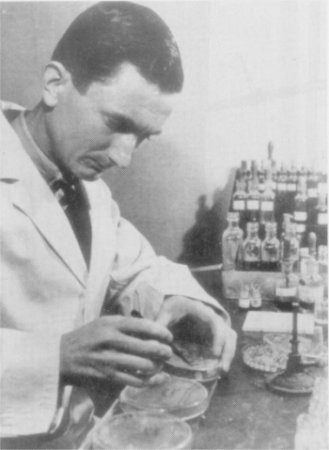
By January 1941 enough penicillin was being made to start tests on humans. These showed that penicillin had the potential to be a miracle cure but there was insufficient penicillin to perform a full clinical trial. To increase production Florey tried to interest British pharmaceutical companies but they were too tied down by wartime commitments. He also approached other academic institutions but they were not prepared to help either.
Florey’s final option was to ask the Rockefeller Foundation, which was funding some of the work, to solicit the help of an American pharmaceutical company. The Foundation agreed and paid for Florey and Heatley to travel to the USA to meet with prospective partners.
Florey and Heatley flew to New York in June 1941 and within two weeks they had been offered the help of the government’s fermentation scientists at the Northern Regional Research Laboratory at Peoria, Illinois. Heatley spent 5 months there and then 7 months working with Merck, the American pharmaceutical company which agreed to produce penicillin. By the time Heatley returned to England in July 1942 the scientists at Peoria had increased the yields of penicillin more than thirty-fold by using different fermentation techniques and a new strain of mould, discovered growing on a melon. Within a year four other American pharmaceutical companies had started to produce penicillin. Treatment of US soldiers in the Pacific war zone began in April 1943.
By the end the year the production of penicillin was the second highest priority of the American War Department and another twenty-one companies were making penicillin. Only the development of the atom bomb was considered more important. In the first 5 months of 1943 enough penicillin to treat 180 severe cases was produced. In the following 7 months enough to treat 9,225 such cases was manufactured. By D-day, June 6th, 1944, there was enough to treat 45,000 cases per month. When the work on the new fermentation techniques was published by the American team Heatley’s contribution was not mentioned and much of the ensuing financial rewards from penicillin went to the US.
During Heatley’s absence from Oxford his colleague scaled up his production line. By September 1942 this apparatus was also processing mould juice from Kemball-Bishop, the London fermentation company, and soon after ICI was sending mould juice as well. From 1942 to 43 some 183 patients were treated and in May 1943 Florey went to North Africa to oversee the use of penicillin on wounded soldiers. The Therapeutic Research Corporation, a consortium of the five largest British pharmaceutical firms, eventually took up the production of penicillin and shared information with the American companies and the US Office of Science Research and Development.
Fleming and Florey were knighted in June 1944 and in October 1945 the Nobel Prize for Physiology and Medicine was award to Fleming, Florey and Chain for the discovery of penicillin and its curative action. There was no award for Heatley who was the first to extract penicillin in a form that allowed its therapeutic potential to be demonstrated and who designed and set up the first production line. Florey and Chain received the Nobel Prize because they were the leaders of the Oxford team. Heatley was judged to be just a technician who solved a series of problems they identified.
It is a matter of speculation as to what might have happened if the rules of the Nobel Prize had not restricted the maximum number of recipients to three. In 1998 Professor Sir Henry Harris, former Head of the Dunn School of Pathology, was of the opinion that Heatley’s work would likely be more appreciated today, in a time when the Nobel Committee places greater value on direct contribution. Sir Henry went on to say that Heatley ‘was put up for the Royal Society but the rumour was that, because of his diffidence, people regarded him as just a pair of hands for Florey. It was a great injustice. When assessing the contributions of the main protagonists in the penicillin story Sir Henry stated ‘Without Fleming, no Florey and Chain; without Florey, no Heatley; without Heatley, no penicillin.’
Heatley was always very modest about his role in the team and never complained about his lack of recognition. He worked with Florey for 30 years. Heatley was appointed a Nuffield Research Fellow at Lincoln College Oxford in 1948 and received an OBE in 1978. The most significant indication of the value of his work on penicillin came when Oxford University awarded him an Honorary Doctorate in Medicine in 1990, the first given in its 800-year history. When he died in 2004 the obituaries in many newspapers called him “the unsung hero of penicillin production during the Second World War”.