Home > The Story of Woodbridge > Retail Trade
Retailing
Across the country retailing, the sale of goods in small quantities, started in markets. The first regulated markets were created during the Anglo-Saxon era and, after the Norman Conquest, their numbers increased considerably. Markets were the key link between the growing urban centres and the surrounding agricultural hinterland. They were the urban dwellers’ source of food and of the raw materials needed for their occupations.
Each market was established by the grant of a charter by the Crown to a lord of a manor who was thereby entitled to hold a market on a given day of the week, to charge rent for a space in the market and collect a tax on the goods sold. In return the lord had to enforce the use of standardized weights and measures.
On the days at which the market was held the lord could ban the buying or selling of goods in all other places in the manor. Such bans caused conflict when rising trade led to shops being set up in the fifteenth century.
Shops eventually became an essential feature of everyday life because they were more convenient than markets, and they were open much longer and often sold goods on credit to regular customers. For a while shops and regulated markets vied for retail trade but eventually shops dominated.
Woodbridge Market
Woodbridge Market was established in Woodbridge in 1172 following the grant of a Market Charter to the lord of the manor of Woodbridge Priory. A charter to hold two fairs per year was probably granted at the same time.
At Woodbridge Market there was a burgeoning local trade in livestock, leather and dairy produce. The market was dominated by butchers and leather workers and, in the 1440’s, the manorial income from butchers’ stalls was four times that generated by bakers and grocers.
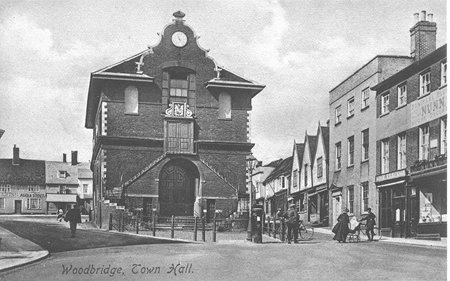
When Woodbridge Priory was dissolved in 1535 and the right to hold a market passed to the lord of the manor of Woodbridge late Priory. In 1574 the then lord, Thomas Seckford, improved the market by building the Shire Hall in the centre of the town. The lower part, which then had open arches rather than windows, was used as a covered market. Other market stalls and animal pens continued to be laid out around the rest of the Market Hill. The upper floor of the Shire Hall was used for Quarter Sessions of the County Court.
By the fifteenth century markets were increasingly facing competition from shops because the latter were open daily. The best local example is Ipswich where, throughout the 1460s and 1470s, there were attempts to ensure that butchers sold their produce from market stalls at fixed times, rather than from their own homes where their hours of business were more flexible.
In 1756 the lord of the manor of Woodbridge late Priory requested legal advice on what to do about some butchers who refused to close their shops on market days. He was also concerned about the ‘shopkeepers who were buying butter cheese and other such commodities coming into this town to be sold before the said commodities are taken into the market.’
By 1800 it is clear that the lord of the manor of Woodbridge late Priory had ceased to exercise his market rights. Although the market was still taking place he was no longer erecting stalls on the Market Hill and he was not collecting tolls or stallage on market days.
In 1803 the open arches in the lower part of the Shire Hall were partly bricked up and windows were installed. The space created was used as a corn exchange which was run by the ‘Corn Market Committee’ until they decided to close the exchange in 1941.
During the first half of the nineteenth century various trade directories describe the market as being plentifully supplied with corn and cattle. The earliest photographs of the market show livestock in pens.
When the Shire Hall was built in 1575 the lower part was open and was used as a covered market.
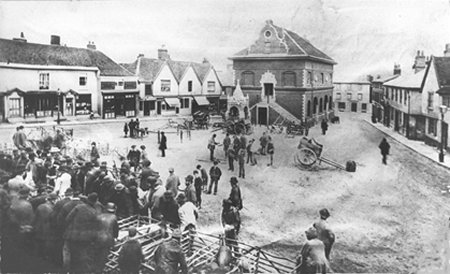
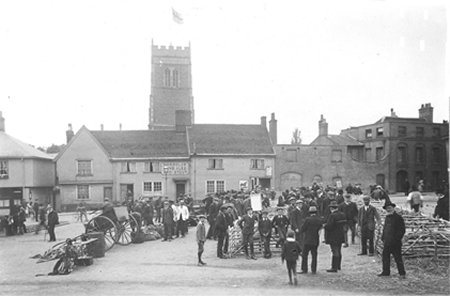
In April 1896 the Urban Council of Woodbridge bought the market rights and it decided to offer yearly leases of the market. Over the next thirty years the market became less popular and the rents received in return for the leases diminished. By 1925 the cattle market was only being held every other week. There is no evidence of the market having been held during the early 1930’s and, in 1936, the council designated the upper part of the Market Hill as a parking space.
Market trading lapsed until 1960 when the Town Council was asked by a trader to give permission to sell fruit and vegetables on the Market Hill every Thursday. For many years the revived market was a thriving concern with standings being available for up to about 15 traders, but by 2002 the number of traders had fallen to 5 and they lobbied to Town Council to allow them to move down to the Turban Centre. The last market on Market Hill was held on 9 May 2002.
Woodbridge Shops
The 1560 Extent of Woodbridge late Priory mentions four shops in the town but, as the document was a compilation of several sources, the data it contains on commerce is unlikely to be comprehensive. One of the shops mentioned was on Market Hill and three others and a tavern were around the junction of Church Street and The Thoroughfare. There were also two bake houses. At that time some shops would have been little more than craftsmen’s workshops. Metalworkers, carpenters, leatherworkers, shoe makers and potters etc would have produced goods for the townspeople and for the country people who came to buy and sell in the market.
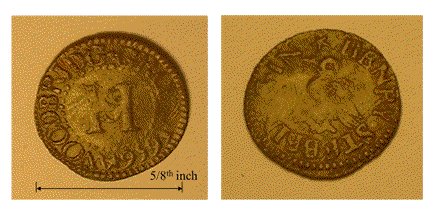
In the mid seventeenth century there was a desperate shortage of small denomination coinage. To encourage trade, local shopkeepers minted their own copper coins to give as change. A quarter penny token issued by a Woodbridge Grocer in 1656 is shown here.
The only way of estimating the number of shops in Woodbridge during the eighteenth century is to use an Excise survey of 1759. According to this source there were 15,113 shops across Norfolk and Suffolk serving a population of about 512,000. On this basis there were 34 people to every shop and, if this were the case for Woodbridge, there would have been about 60 shops in the town. It is thus not surprising that the lord of the Woodbridge Market was complaining of the loss of trade to shops in 1756.
Many of these shops were likely to be petty shops, small shops which typically sold candles, bread, small beer and a diverse range of small articles to artisans and labourers, but there would also have been bigger shops selling meat, groceries, clothing, draperies and household goods to the more affluent.
The next record of the number of shops in Suffolk was produced in 1789 when a tax was levied on those having an annual rent of greater than £5. The data for some towns, including Woodbridge, has not survived but that for Beccles and Bungay has. Using the data for these two towns, which were comparable in size to Woodbridge, it is estimated that there were 44 shops in Woodbridge having an annual rent of greater than £5. This is somewhat smaller than the 60 estimated using the 1756 data but this number included shops with an annual rent of less £5.
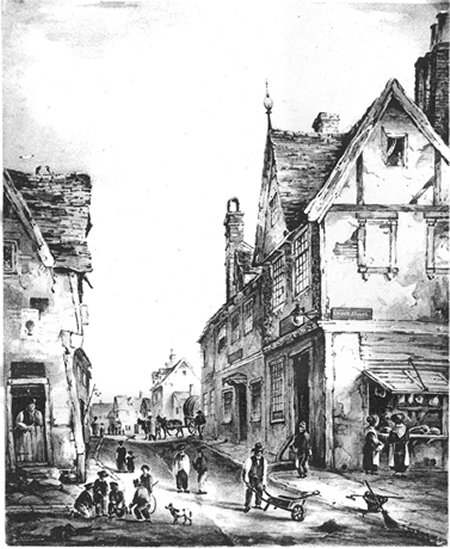
The earliest image of a shop in the town is shown on the left. It is a painting by George Rowe and it shows goods being sold from the open window of a shop at the corner of Church Street and Cumberland Street in 1832. By 1838 this building is listed as a grocer’s shop run by Frederick Mathew.
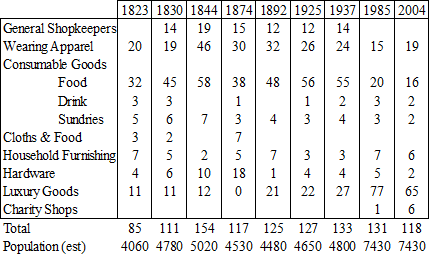
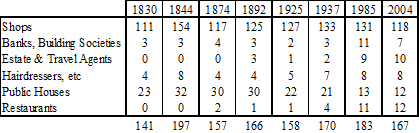
Trade directories from 1823 to 1937 provide a comprehensive picture of the evolution of shops in Woodbridge. The data they contain, and that from two surveys undertaken in 1985 and 2004, is presented in this table. The total number of shops in each year is at the bottom of the table as is the population of the town.
The changes in the number and type of shops reflects changes in the population and prosperity of Woodbridge. To explain them its necessary to look more closely at what happened during three very different periods during evolution of the town.
1823 to 1859 – A Period of Increasing Population
1859 to 1930 – A Period of Static Population After a Sharp Fall
Over this period the population of the town remained static after a 13% fall following the arrival of the railway in 1859. The number of shops in the town decreased by 24% between 1844 and 1874 and then rose by 8% over the period 1874 to 1925. The types of shop did not change significantly over this period. By far the largest number sold either food or wearing apparel or both. These commodities were the bare necessities and most families could afford little else. The same pattern has been found in towns across the country.
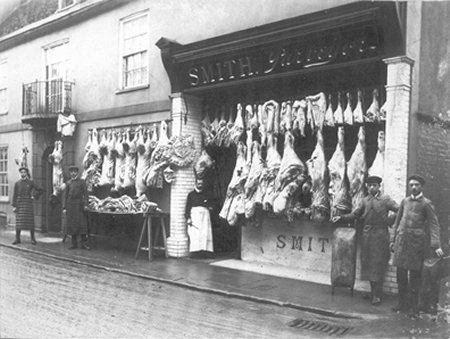
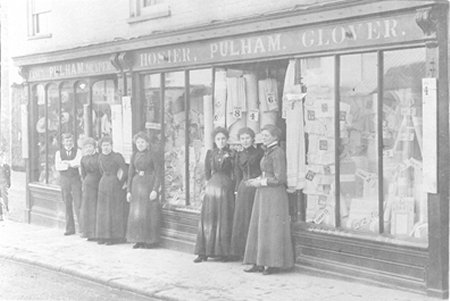
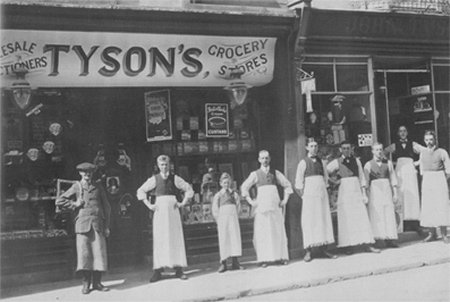
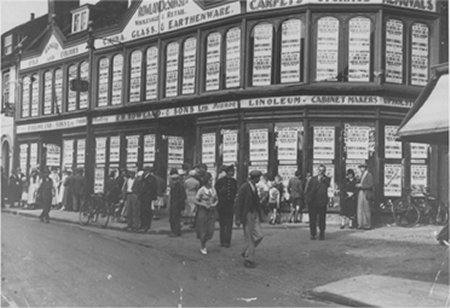
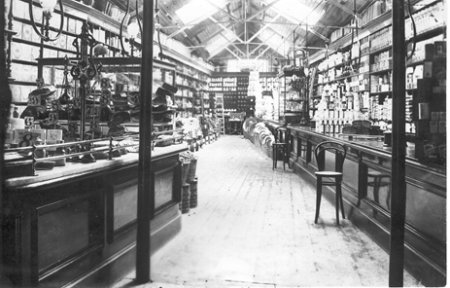
The food was usually prepared and packed on the premises. Butchers slaughtered their own animals, bakers made their own bread, and provision merchants sliced their bacon and cut butter and cheese from blocks. Many clothes and shoes were still made or altered in the shops. Because of the large amount of manual labour involved in the retail trade, both the number of people employed, and the number of shops needed to service a given population, was greater than today. Many photographs of Woodbridge shops have some or all the staff lined up outside and they clearly show how labour intensive the retail trade was.
Tyson’s grocery store on The Thoroughfare. It was demolished in the 1960s to make way for the Job Centre.
Two topsail schooners at the Common Quay.
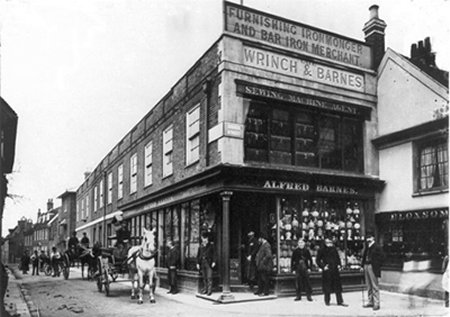
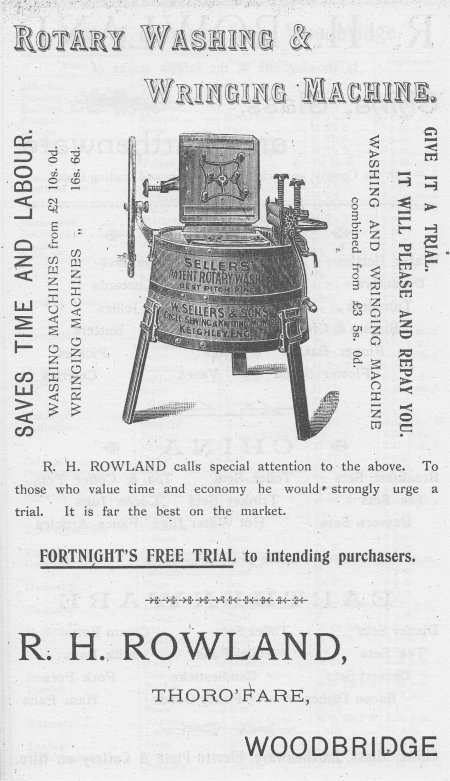
Adverts showing the range of products offered for sale in 1901
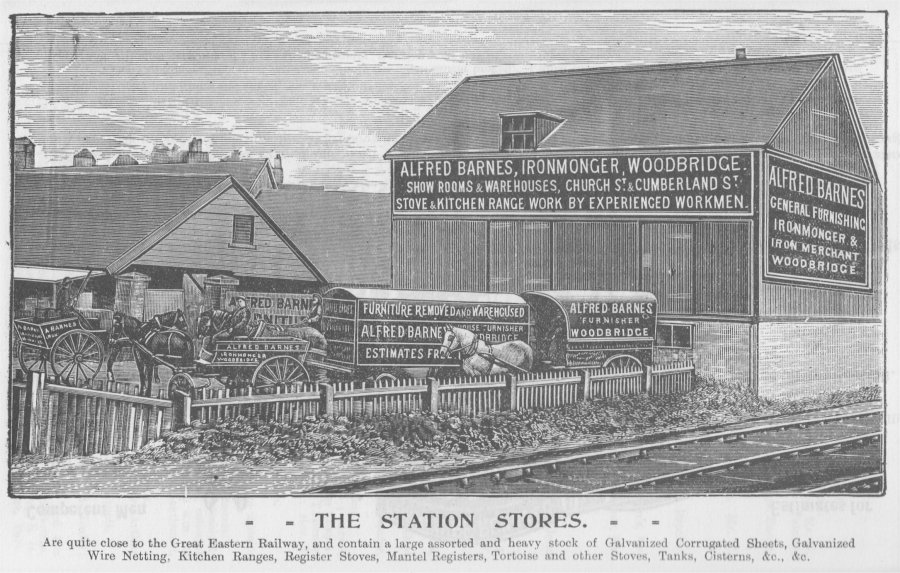
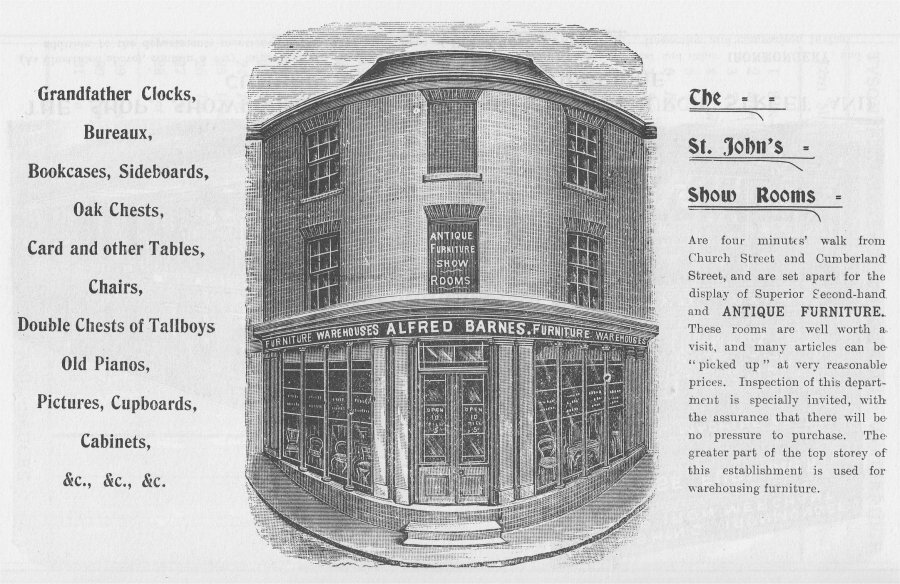
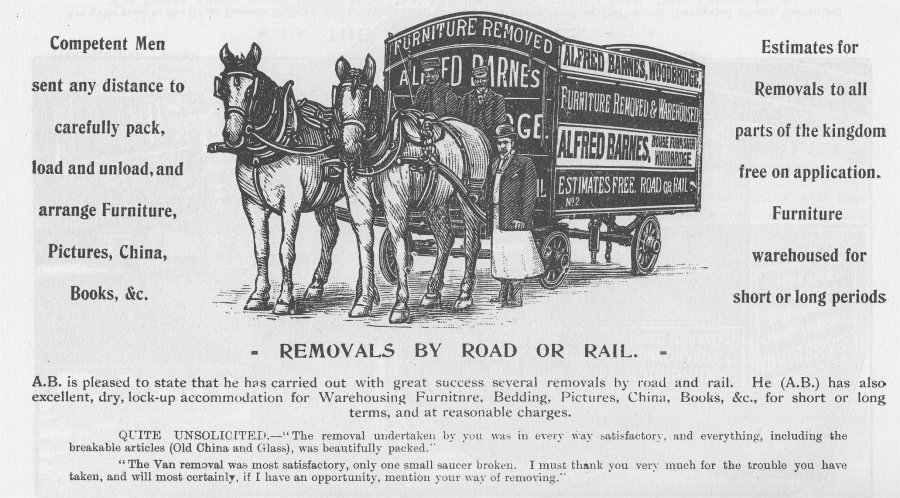
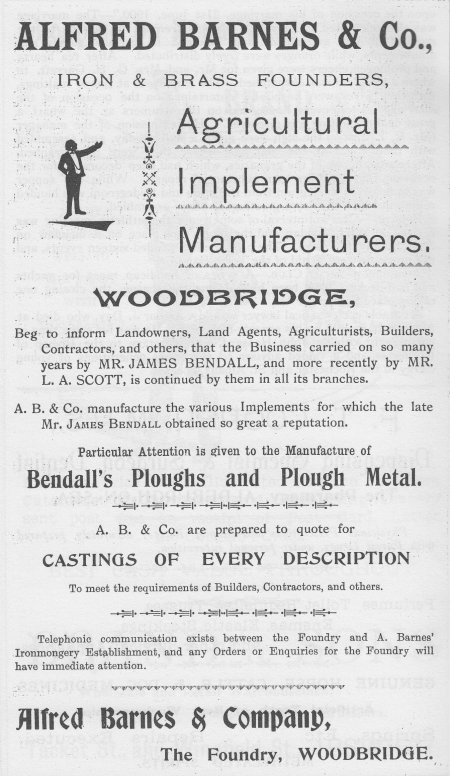
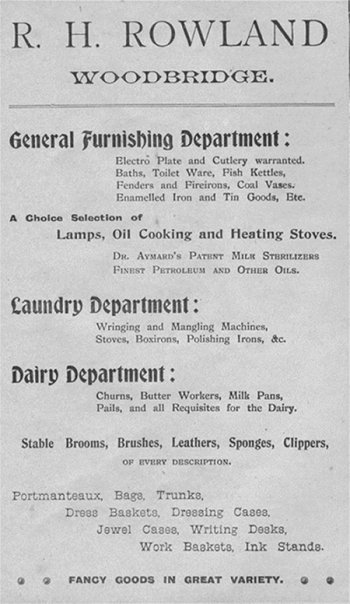
R H Rowland's Adverts Placed in the 1901 Lambert's Almanack
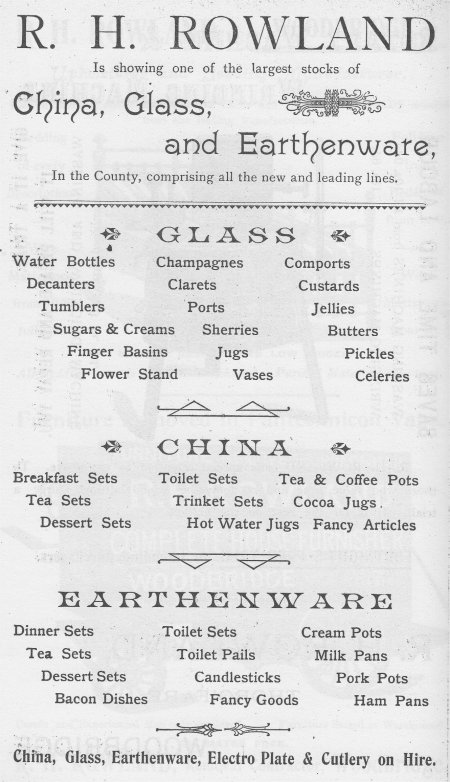
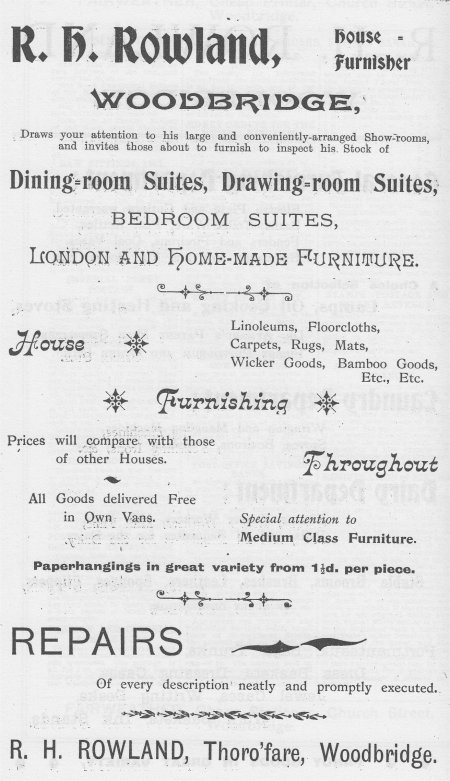
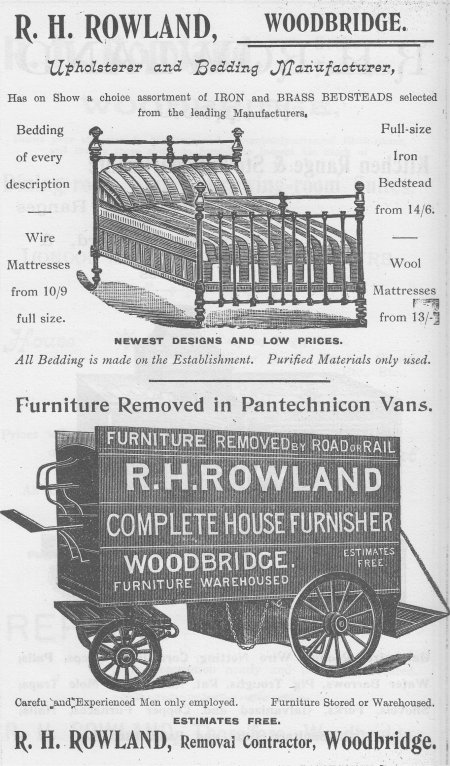
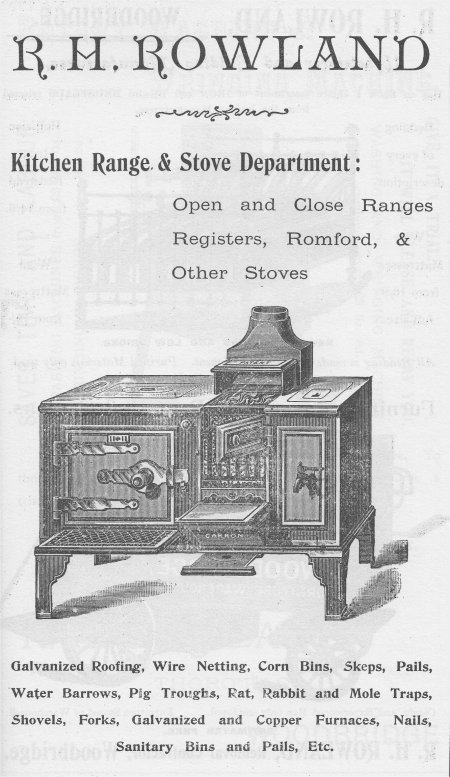
Some retailers increased their profitability by opening branches in new areas and became known as chain-stores. Between the 1870s and the mid-1890s, most chain stores sold either footwear or grocery. Then there was a marked growth in chain stores selling either meat, men’s clothing, women’s wear or chemists’ goods.
The number of such stores in Woodbridge is shown by this table. In 1874 the only national chain store in the town was Clark’s Boots and Shoes. The other chain stores were all confined to south east Suffolk. They included the draper Footman & Pretty and the grocer Joseph Turner which were both offshoots of shops in Ipswich. They were both still in Woodbridge when, in 1892, they were joined by two national chains – The Industrial Co-op Society who had a branch selling groceries and an outlet of the boot manufactures Freeman, Hardy & Willis.

Post 1930 – A Period of Rising Population and Prosperity
During the 1930s retailing was transformed. The number of food stuffs coming ready packed increased as did the number and range of ready-made clothes. The buying process became less time consuming for the customer and consequently fewer food shops and clothes shops were needed to serve a given population.
Then, with rising prosperity during the 1950’s, there was a demand for luxury goods such as carpets, furniture, radios and refrigerators. When the house had been furnished there was a rapid expansion in shops dealing in other luxury goods – jewellery, books, records, sports equipment, cameras and a succession of new products. To meet this new demand there was a growth in the number of shops selling luxury goods.
By the mid 1960s retailing in the town was still in transition. There were still a number of butchers and grocers in the town but by 1985 many of them had closed. This was due to the rapid growth in the number of supermarkets during the 1970’s and they soon dominated the retail trade. Because of the rise in car ownership, many of the new retail outlets were located in or near the larger urban centres and this resulted in a noticeable reduction of the number of food shops in the smaller towns. The growth of large chain stores selling clothing in the cities had a similar impact on the number of shops selling wearing apparel in small towns.
Most of the independent shops left in the smaller towns like Woodbridge have to either specialize in niche products and/or to attract customers who value personal attention. As a result the number of shops has fallen slightly since 1985.
The independent shops are now facing a new threat. Over the last few years many of the big chain stores have spawned smaller outlets and these are increasingly appearing in the smaller towns. In Woodbridge the number of chain stores has risen from 5 in 1937, to 13 in 1985 and to 15 in 2004. If this goes on unchecked there is a danger that the high street will loose its individuality and it will become the same as in many other towns.
The Change in the Distribution of the Shops
Despite the reduction of shops in Woodbridge the main retail areas still seem to be busy. This is because some of the shops which have disappeared have been replaced by travel agents, estate agents, hairdressers, banks and building societies. The number of public houses has also reduced but this has been partly compensated by a dramatic increase in restaurants. These changes are summarized in this table.
Additional Information on The Public Houses in Woodbridge
The Public Houses in Woodbridge
In sixteenth century documents there are references to a brewery in Woodbridge and to meetings in buildings which are believed to be inns or taverns. It is not until the early nineteenth century, however, that it is possible to produce a comprehensive list of the inns, taverns and beer houses in the town.
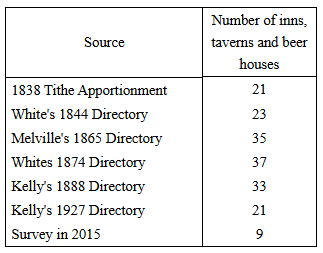
In 1828 Isaac Johnson produced a map of the town showing the locations of twenty-one inns or taverns, and the tithe apportionment of 1838 lists twenty-two inns or taverns and one beer house. Thereafter the only listings of inns, taverns and beer houses are to be found in trade directories. These lists have two limitations. Firstly, none of the early directories distinguish between inns and taverns. Secondly, although some directories clearly identify beer houses, others treat them as inns or taverns. Because of these two limitations, it is only possible to use directories to obtain the total number of inns, taverns and beer houses in the town. Today such establishments are collectively referred to as public houses.
Using the various sources mentioned above it is possible to show how the number of public houses in Woodbridge has changed since 1838 and the results are presented in the table on the right. The number of public houses rose from 23 in 1838 to a peak of 37 in 1874 and then declined to 20 by 1937. By 2015 there had been a further reduction to 9. All but 3 of the post 1937 closures occurred between 1950 and 1972.
Of all the public houses which remain in the town, the Mariner’s Arms is the only one which is not at least 300 years old. The Angel, the King’s Head, the Bell and Steelyard and the Crown are all believed to date back to the 16th century. The Bull and the Crown have the distinction of being coaching inns which had extensive stabling.
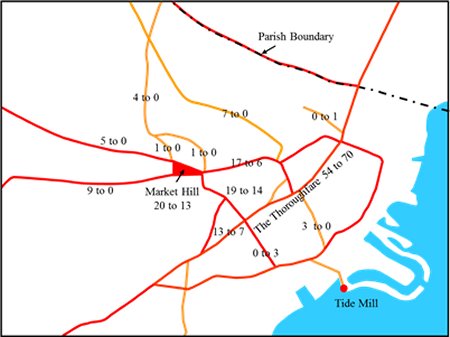
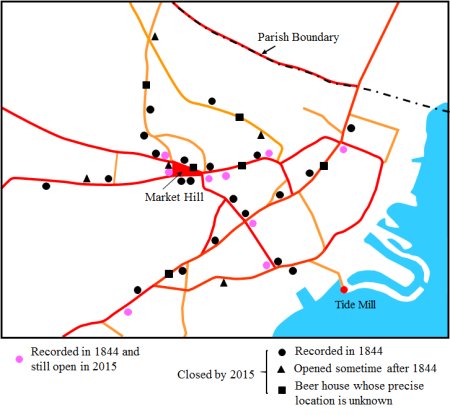
The locations of the public houses are shown by the map on the right. The pink circles mark the locations of those which were recorded in 1844 and were still open in 2015. The black circles, triangles and squares mark the locations of public houses which had closed by 2015. Black circles are used for those which were recorded in 1844, black triangles for those which opened some time later and black squares for those whose location can only be narrowed down to a particular street rather than a building.
Public Houses in Woodbridge From 1839 to the Present
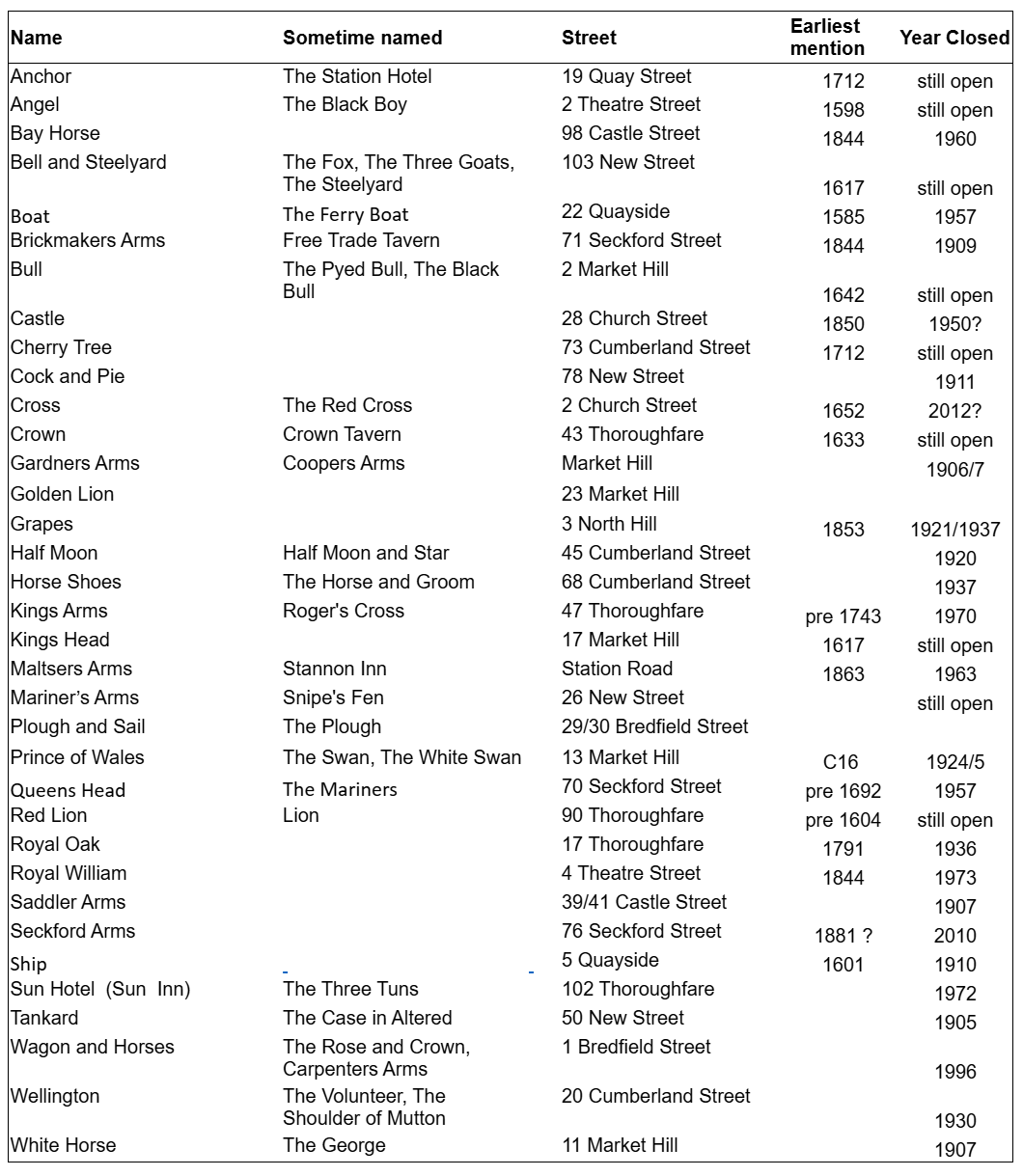
Public Houses excluded from the above List
Two public houses have been excluded from this list because they are near the outskirts of the town and were both established comparatively recently.
Shortly after the Second World War an estate of council houses was built either side of the parish boundary between Woodbridge and Melton. The estate was along two new roads, Warwick Avenue and Edwin Avenue. As well as the houses there were also four retail units and in 1958 one of these became a public house called The Warwick. The name has changed several times since.
From 1804 to 1815 there was a large barracks on the outskirts of the town for 4000 troops involved in the Napoleonic War. To provide them with entertainment a public house, The Duke of York, was build adjacent to the barracks but it was demolished along with the barracks in 1815. A new public house was eventually built on the site of the old one in 2000. It was initially called The Seal but the name was eventually changed to the Duke of York.