Home > The Story of Woodbridge > Liberty of St Etheldreda
The Liberty of St Etheldreda
From the late Anglo Saxon period until 1930, the legal system in Woodbridge, and in the surrounding area, was linked to the Liberty of St Etheldreda. The evolution of this Liberty, and that of the legal system and the policing within it, will be described here.
When the small Anglo-Saxon kingdoms began to coalesce into bigger ones, the kings started to compose laws which sought to compensate the victims of crime rather than punish offenders. To cover the cases where the parties could not agree on the amount of compensation there was a tariff fixed according to the social status of the injured party.
Enforcing these early laws proved to be difficult so, by the late Anglo Saxon period, kings started to intervene to punish those who committed crimes. This led to the gradual emergence of the concept of a breach of the king’s peace. An offender could no longer redeem himself by the payment of compensation to the injured party, but was now entirely at the mercy of the king. For serious offences, which ranged from theft to murder, the penalty was usually death and the king received the land and worldly goods of all those who were executed. Minor offences were dealt with by a period in a pillory or stocks.
The duty of identifying and apprehending the persons believed to have committed crimes remained the responsibility of the community. The community in each hundred, a subdivision of the counties (shire) also played an essential part in the trials of those accused of committed a crime.
The Hundreds
Domesday Book, complied in 1086, lists 25 hundreds in Suffolk, but by 1800 the number had been reduced to 21. Woodbridge was part of the Loes hundred.
Each hundred had a court which administered the law and endeavoured to spread equitably the fiscal demands of the king. Most men living in the hundred could attend its court and its judgments were decided by them. The men were guided, but not controlled, by the sheriff (the ‘king’s reeve’) who presided. All crimes committed in the hundred were presented to the court and those which were considered to be outside its jurisdiction were forwarded to a biannual county court which was presided over by an eorl and a bishop.
The Liberties in Suffolk
In some parts of the country the rights of the king were passed to privileged magnates or ecclesiastic foundations. The legal system within these areas, which are called Liberties, was structured in the same way as that in the rest of the country but it was supervised by the magnates or the ecclesiastic foundations. Moreover, they received any fines imposed and the land and goods of those who were executed. In effect the legal system in each area operated as a mini-shire and there was a steward and bailiff rather than a sheriff.
The county of Suffolk was unusual in that it contained two Liberties and the boundaries of each are shown here. The Liberty of St. Edmund was granted to St Edmund’s Abbey and The Liberty of St Etheldreda was granted to Ely Abbey. Less than half of Suffolk was under royal jurisdiction and, because of this, Suffolk shared a sheriff with Norfolk until 1576.
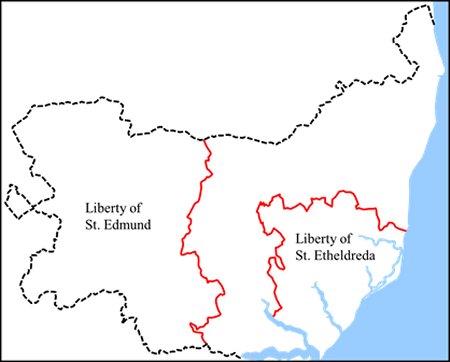
The Origin of the Liberty of St Etheldreda
The Liberty of St Etheldreda was first recorded in a document relating to the rededication of Ely Abbey in 970. This abbey was the result of an endowment at Ely by Etheldreda, the daughter of King Anna, who ruled East Anglia from 636-654. It is believed that the Liberty of St Etheldreda was even older than the earliest reference to it, and that it was part of the original endowment of a convent founded at Ely by Etheldreda in 673. This convent eventually became part of Ely Abbey.
The Liberty of St Etheldreda encompassed the former Royal Hall at Rendlesham and the royal pagan ship burials at Sutton Hoo and Snape. It was thus the heartland of the pagan Kingdom of East Anglia. Some historians suggest that the decision to grant away this area to a monastery may have been an action to distance the, then Christian, royal family from its pagan past. The first Christian Kings of East Anglia, Sigeberht and Anna, were both buried outside the area which became the Liberty as was the Royal Hall which Anna moved from Rendlesham to Blythburgh.
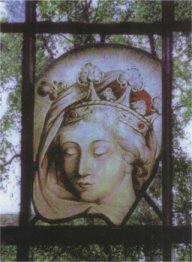
More on Etheldreda – Princess, Queen, Abbess and Saint
Etheldreda
Etheldreda’s father Anna, a devout Christian, was King of East Anglia from 637 to 653. Sometime after Anna’s first wife died his daughter Æthelburh and his stepdaughter Sæthryth were sent to a nunnery at Faremoutiers in France for their education. Æthelburh became a nun and eventually succeeded the abbess. Sæthryth also became a nun and succeeded her sister as abbess.
Anna married for a second time and had a son Jurmin and three daughters who also eventually became abbesses. The eldest of these daughters was Seaxburh who was born in about 626. She married King Eorconberht of Kent about 2 years after his accession in 640. After his death in 664 she ruled the kingdom until their son Ecgberht was grown, and then, probably about 670, founded a nunnery at Sheppey, endowed it, and settled there with seventy-seven disciples. About 675, in consequence of a dream, she departed from Sheppey, leaving her daughter in her place, and went to Ely, where she succeeded her sister Etheldreda as abbess in 679.
Withburga, the youngest daughter, was not a strong child and was sent to Holkham on the Norfolk coast for the sake of her health. She developed into something of a recluse but she eventually founded a nunnery at East Dereham after the death of her father and became its first Abbess. Withburga died in 743 and was buried at East Dereham but, in 974, she was moved to lie beside her sisters at Ely.
Etheldreda, the middle daughter, was born in 631. Very little is known about her early life apart from that, before she had reached the age of 21, she had decided to give her life to God and become a nun. When she made this decision, and what influenced it, is a matter of speculation.
Etheldreda was an infant when Sigeberht became king of East Anglia and the process of conversion of the population of East Anglia to Christianity began in earnest. She grew up in a Christian household and would have been influenced by Bishop Felix until he died when she was seventeen. She also may have met both the Irish monk named Fursey, who established a monastery at Burgh Castle, and Botolph, who is believed to have founded a monastery at Iken by the Alde estuary. Seven other monasteries had been established in Suffolk by the time Etheldreda was fourteen.
Some historians have suggested that Etheldreda’s decision to become a nun may also have been influenced by contact with two sisters, Hereswith and Hilda. They were related to the Eadwine, the king of Northumbria from 616 to 632. Hereswith married Anna’s brother Æthilric and she might have remained in Suffolk sometime after he was killed in 637. She eventually left England in about 644/5 and took up a religious life in Gall. Her sister Hilda, who was 14 years younger, had been taught by Bishop Aidan of Lindisfarne.
Hilda reputedly came to East Anglia in about 647 in the belief that her sister Hereswith was still there. Hilda stayed for a year before leaving to enter a convent by the River Wear. A year later Aidan appointed Hilda as the second Abbess of Hartlepool Abbey and, in 657, Hilda became the founding abbess of Whitby Abbey. While Hilda was in East Anglia Etheldreda would have been about seventeen and if, as seems likely, the two spent some time together this may have had a strong influence on Etheldreda’s decision to become a nun. This decision did not, however, prevent her father arranging for her to marry Tonberht, a prince of an area named South Gyrwe in the southern part of the Fenland.
Etheldreda's Marriages
Etheldreda was 21 when she married Tonberht who was much older than she was. Etheldreda managed to persuade Tonberht to respect her vow of perpetual virginity. He died in 655, only four years into the marriage, but Etheldreda retained the Isle of Ely which she had received from him as a morning gift (one made by a the husband to his wife the morning after the marriage). Some historians suggest that, after the death of Tonberht, Etheldreda went to live on the Isle of Ely.
In 653 King Anna and his son Jurmin were killed when the Mercian army attacked East Anglia. Anna was succeeded by his brother Æthelhere who formed an alliance with Mercia against Northumbria. Within a year Æthelhere was killed, along with the King of Mercia, in an attack on the Northumbria and Æthelwald, and another brother of Anna, ascended to the throne of East Anglia.
Æthelwald was subservient to Oswy, the King Northumbrian. In 660, to strengthen his position, Æthelwald arranged for his widowed niece Etheldreda (then aged 29) to marry Ecgfrith, Oswy’s 15 year old son. Little is known about Etheldreda’s life during the next decade apart from that she refused to consummate the marriage because of her vocation to become a nun. In 670 Oswy died and Ecgfrith and Etheldreda became King and Queen of Northumbria. Etheldreda continued to insist on remaining a virgin so Ecgfrith asked Wilfred, the Bishop of Northumbria, to intercede and to persuade her to give him an heir. The accounts of the subsequent events are varied but the key facts are clear. In 672 Wilfred persuaded Ecgfrith to allow Etheldreda to enter the monastery at Coldingham, near Berwick. A year later, after being warned that Ecgfrith was about to send men to seize her, Etheldreda fled south accompanied by two nuns.
The Founding of the Double Monastery at Ely
Etheldreda and her companions made their way to her own estate on the Isle of Ely and, in 673, she founded a double monastery there. It is generally presumed that the resources needed to establish these monasteries were provided by Etheldreda’s East Anglian relatives but the only evidence of this comes from a later period. The double monastery and all their records were destroyed during the Danish invasion. It is not until 970, when the double monastery was re-founded, that mention is made of them being endowed with the Liberty of St Etheldreda. The Liberty encompassed the former Royal Hall at Rendlesham and the royal pagan ship burials at Sutton Hoo and Snape. It was thus the heartland of the pagan Kingdom of East Anglia. The decision to grant away this area to the monasteries may thus have been made in 673 to distance the, then Christian, royal family from its pagan past. The first Christian Kings of East Anglia, Sigeberht and Anna, were both buried outside the area which became the Liberty, as was the Royal Hall which Anna moved from Rendlesham to Blythburgh.
On the 23rd June 679 Etheldreda died at Ely as the result of a plague which had caused her to have a high fever and a tumour in the neck. Her physician lanced the tumour, and for a couple of days the operation seems to have been successful. The swelling went down, and the fever was reduced, but by the third day her condition worsened and she died. In his chronicle the Venerable Bede records that she “took great joy in this kind of sickness” saying “I know for certain that I worthily bear the burden of pain in my neck, because I remember, that when I was a girl, I bore the superfluous burden of necklaces, and I believe that the heavenly pity has therefore willed me to be grieved with pain in my neck, that I may be acquitted from the guilt of useless vanity, so that now instead of gold and pearls the redness and burning of the swelling breaks out of my neck. She had been Abbess for 6 years and the Ely community unanimously elected her elder sister Seaxburh to succeed her.
Sixteen years after Etheldreda’s death, it was decided to take what remained of her body from the grave in the churchyard where she had wished it to be, and place it within the church. When Etheldreda’s coffin was disinterred and opened her body showed no sign of decay and its linen wrappings were whole and fresh. The only sign of the tumour which had been removed from her throat was a slight scar. This was accepted as a miracle, the final proof that Etheldreda was a great saint. The nuns washed, and re-clothed the body before putting it into the coffin and all proper rites, enshrined it in the church on 17th October 695.
Etheldreda’s shrine at Ely soon became a place of pilgrimage and the old wooden coffin and grave clothes, which were preserved as relics, were of great power and many miraculous healings were reported.
In memory of her, English women used to wear round their necks a chain made of fine small silk, which was called St. Etheldreda’s chain. Her name, shortened to Audrey, was given to a cheap kind of lace, and changed still further into tawdry, applied to things more showy than valuable, such as the trinkets sold at the great fairs held in her honour at Ely.
Under Abbess Seaxburh the community at Ely flourished for about twenty years, until her death on 6th July 699. In accordance with her wishes her body was placed in the church next to that of her sister, Etheldreda.
Ermenilda, Seaxburh’s daughter, became the next abbess. She had been trained under Etheldreda, but at her mother’s request, had gone to take charge of the foundation at Sheppey. Ermenilda was succeeded by her famous daughter Werburga, who had also received her initial training under Etheldreda. Werburga had followed her mother as abbess of Sheppey, and then, at the King of Mercia’s (her uncle Ethelred) request, she had founded monasteries at Hanbury, and Trentham in Staffordshire.
Seaxburh, Ermenilda and Werburga were all made saints for the same reason Etheldreda had. Their bodies showed no sign of decay when they were disinterred and moved to a new location within a decade or two of their death. Those who cast doubts on whether such occurrences are a true sign of sainthood point out that the extreme austerity of monastic life would have left monks and nuns reduced to little more than skin and bone and that such bodies are likely to mummify naturally. They also point out that during the final ceremonies the bodies were washed, treated with aromatic herbs, and re-clothed before being put into the coffin and that such treatment may have prevented decay.
Other miraculous happenings relating to Etheldreda are cited by chroniclers. The best known, is the sprouting of a staff which Etheldreda stuck into the ground preparatory to sleeping while on her progress from Northumbria to Ely. When she awoke next morning the ash wood staff had produced buds, and even new leaves.
The 1066-1600 The Foundations of the Modern System of Criminal Justice
The first major changes to the Anglo-Saxon legal system were made during the reign of Henry II (1154-1189) and they were continued by his successors. From 1166 royal justices toured the country and presided over at both criminal and civil cases at the biannual county courts. At these courts, which later were called the assizes, representatives of each hundred and township were called upon to present all those accused of serious crimes for judgment. A ‘grand jury’, which had representatives of all hundreds in the county, then had to examine each case and to decide whether there was sufficient evidence to warrant the accused being tried.
By the middle of the thirteenth century the recording of serious crime was reported to royal officials, called coroners, who were appointed in every county. The appointment of the coroner reduced the role of the sheriff who was left with the jurisdiction over personal actions such as debt and private wrongs and the responsibility for collecting the king’s taxes and for maintaining the prisons. The latter were then only used to detain those awaiting trial or execution.
From 1277 keepers of the peace were appointed for each county to instigate proceedings against people who were believed to have broken the laws, and to have them held in custody until they could be brought before a royal justice. The function of the keepers of the peace were eventually taken over by justices of the peace. In 1388 there were eight justices of the peace in each county and they were enabled to try criminal cases, but not civil ones, at the ‘courts of quarterly sessions’ held at four set times each year. The justices of the peace, who are now called magistrates, were mainly leading landowners. By 1565 there were 30 or 40 justices of the peace per county.
Each manor appointed an unpaid constable who was initially just responsible for keeping the peace and good order within the manor but, in 1285, The Statue of Winchester gave the manorial constable royal authority for maintaining the King’s peace. The manorial constables had the powers of arrest but they did not investigate crimes. The victims of crime usually had to discover the culprits themselves and then fetch the constable to arrest them and bring them before the magistrates. Moreover, the victim was expected to pay the constable for his services.
The legal system in South East Suffolk
It is not known for sure where the sessions of the Liberty of St Etheldreda were held. Wickham Market is the most likely candidate but Hacheston, Sutton and Melton have also been mentioned by some historians. The only facts which can be verified are that, in the sixteenth century, the steward and bailiff of the Liberty resided at Melton where, by order of the Constitutions of Clarendon in 1164, the common gaol of the Liberty was erected.
After the Abbey at Ely was dissolved in 1539 the legal system of the Liberty was incorporated into the national one but it continued to have its own coroner, assizes, quarter sessions and gaol. In effect the former Liberty continued to operate as a mini-shire.
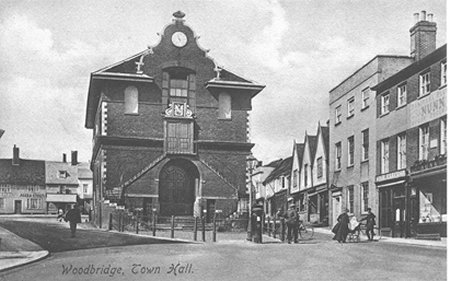
Sometime during the reign of Elizabeth I the eminent lawyer Thomas Seckford, who held the manor of Woodbridge late Priory, became steward of the Liberty. In 1575 he moved its sessions to a Sessions House which he had built in the centre of the Market Hill in Woodbridge. He gave the upper part for the use of the County Court in perpetuity, and the open hall below was used as a covered market for the manor of Woodbridge late Priory. The building has since been referred to as the Sessions House, the Shire Hall or the Town Hall.
By 1800 the Sessions House was still being used for the Woodbridge County Court and Petty Sessions of the 64 parishes that were in the Liberty of Etheldreda. The Quarter Sessions were in January, April, June and October, and the Petty sessions every Wednesday. The last Quarter Sessions were held there on the 17th October 1860. In recent years the Sessions House has been used as a Magistrates’ Court. This court was moved to Ipswich in 1986 and the Town Council purchased the Shire Hall in 1987. The Coroner of the Liberty of St Etheldreda had an office on Market Hill until 1933.
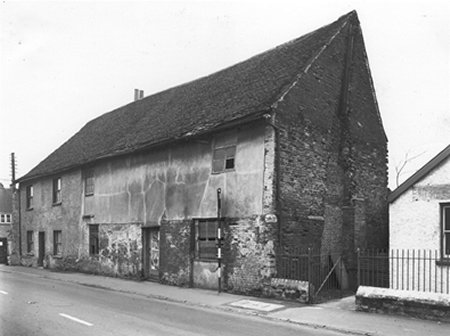
The Liberty’s gaol at Melton remained in use until about 1800 but it was not demolished until 1962. By then the Steward’s and the Bailiff’s residences had already been removed and all that remained were the gaolers’ and the prisoners’ quarters. These comprised a two storey, oblong medieval structure constructed of brick on the ground floor and timber framed on the upper floor. Dutch prisoners who had spent time at the gaol after the battle of Sole Bay in 1672 had left carvings of ships and windmills cut deep into the walls of the rooms they had occupied. Offenders sentenced to death are believed to have been hung on the gallows which were on the hill beyond Wilford Bridge – a site that is also believed to have been an ancient “hundreds” meeting point.
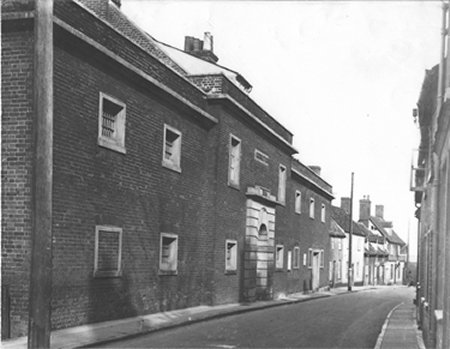
The former House of Correction on Theatre Street.
Article on policing in the Liberty
During the seventeenth century manorial constables were replaced by parish constables appointed by two Justices of the Peace in Petty or Quarter Sessions. The parish constables, like their predecessors were unpaid and were not expected to investigate crimes. Their prime duty was to bring those accused of a crime before a Justice of the Peace.
The first steps towards a modern police force took place in London in 1815 when a force of plain clothed officers on the streets and a uniformed horse patrol were set up. The success of this force in patrolling the streets, investigating crime and arresting offenders lead, in 1829, to Sir Robert Peel, the Home Secretary, setting up a police force for London. The result was a rapid reduction in the number of crimes and soon the new force was being replicated in some other cities and large towns. From 1835 every municipal borough had to create a police force along the same lines as that in London.
Towns and villages continued to rely on parish until 1839. In that year an Act of Parliament was passed which gave all gave counties the opportunity to establish full-time police forces, headed by a Chief Constable who was appointed by the justices of the peace of the county.
In July 1839 the Woodbridge Magistrates backed the formation of a paid police force on the grounds that “the present system of parish constables has become inadequate to the due prevention and detection of offences against the Game Laws”. By the 6th February 1840 it was agreed to set up the East Suffolk Police – one of the oldest county constabularies in England. It was initially to have a chief constable, 3 superintendents and 60 constables. The ranks of inspectors and sergeants were introduced two years later. The headquarters of the force was at Yoxford. From 1842 the Woodbridge Division was in the former House of Correction on Theatre Street and in 1931 it moved to a new building on Grundisburgh Road. This building was sold in 2015 and the police moved to an extension of the Fire Station on Theatre Street. The extension is diagonally opposite the former House of Correction.
A comprehensive account of the evolution of the criminal justice system.
The Anglo-Saxon Legal System
By the time the concept of a breach of the king’s peace had been introduced the whole of England had been divided into counties (shires) and these had been subdivided into more manageable units called hundreds.
Each hundred had a court which administered the law and endeavoured to spread equitably the fiscal demands of the king. (The origin of this court was the less structured public assemblies called folk-moots.) Most men living in the hundred could attend its court and its judgments were decided by them. The men were guided, but not controlled, by the sheriff (the ‘king’s reeve’) who presided. All crimes committed in the hundred were presented to the court and those which were outside its jurisdiction were to be forwarded to a biannual county court which was presided over by an eorl and a bishop. This court met in public and it dealt with cases of murder, theft, affray and wounding. When a person accused of committing a crime came to court and swore under oath that he was guiltless he had to produce sufficient ‘oath-helpers’ to vouch for his character on oath. If he were unable to find sufficient oath-helpers, he had to undergo an ordeal administered by the Church.
Survival of the ordeal was proof of innocence, but most subjected to the ordeal died. Important as these community courts were, they probably did not serve as a great deterrent as the summary justice handed out to those caught in the act of committing a crime, those who fled from a crime or those who unexpectedly left a village. For most of these actions they could expect to be hanged and their land and goods were forfeited to the king. The king also received the fines imposed on those who committed lesser offences.
From the late Anglo-Saxon period a more local enforcement of law and order was conducted through a system called ‘tithing’. Under this system all adult men had be part of a group which was responsible for reporting any offences committed by members of the group to the hundred court. If a group failed to ensure that the offender was brought to justice it had to pay compensation for any damage the offender had caused. The sheriff was responsible for ensuring that all eligible males were members of a tithing group and each group had to pay a sum of money annually to the sheriff to cover his expenses. In many parts of the country each group contained ten men but in large settlements (‘vills’) all adult males sometimes formed a larger tithing group.
Changes from 1085 to 1700
The first major changes to the Anglo-Saxon legal system were made during the reign of Henry II (1154-1189) and they were continued by his successors. By the middle of the thirteenth century the recording of serious crime was reported to royal officials, called coroners, who were appointed in every county. However, the duty of identifying and producing the persons believed to have committed each crime remained the responsibility of the community. The appointment of the coroner reduced the role of the sheriff who was left with the jurisdiction over personal actions such as (i) debt and private wrongs (ii) the responsibility for collecting the king’s taxes, (iii) the frankpledge system and (iv) prisons.
The Prisons were not primarily intended for punishment because most offences were punishable by death or, from 1718, by transportation. They were used to (i) keep prisoners until they were brought to trial or before sentence was carried out (ii) to hold prisoners on state charges or (iii) to detain debtors until their obligations had been settled. Most of the early prisons were established in castles. The Sheriff had two prisons in Suffolk – Ipswich (1163) and Orford (1244) – while the prisons for the Liberties of St Edmunds and St Etheldreda were in Bury St Edmonds and Melton.
Royal Justices
Agreeing to be tried “by God and country” resulting in the evidence being assessed by a ‘petty jury’ of twelve men from the hundreds in the county, some of whom might have been from the grand jury. It is not till 1352 that men from the grand jury were prohibited from serving on the petty jury. The accused had the right to challenge the appointment of up to thirty-five jurors without giving any reason, and the twelve who were selected had to be unanimous before they could convict him.
Manorial Courts
A manorial court was presided over by the lord or his representative and the frequency at which it was held varied from season to season and from place to place. At most they were held about every three weeks and attendance was normally compulsory for all unfree peasants. The court was presided over by the lord or his representative. The way in which cases were examined was similar in form to those used in the other courts but strenuous efforts were made by the court to get the parties to agree to a settlement before a ruling was made. The manor court also appointed a number of unpaid parish officials. One of these was a constable who was initially just responsible for keeping the peace and good order but, in 1285, The Statue of Winchester gave the manorial constable royal authority for maintaining the King’s peace in his manor.
Some manorial lords also had the right to hold a leet court once or twice a year. The right to hold a leet court, which had jurisdiction of a vill (a settlement) rather than manor, was granted by the Crown. The leet court was responsible for running the frankpledge system in the vill and the annual fee that its members had to pay went to the manorial lord rather than the sheriff. The leet court had the power to decide what constituted a minor offence, which it could rule on itself, or whether the offence were serious enough to warrant it being forwarded to the hundred court of the royal justices. All adult males in the vill had to attend the leet court and it was from them that a jury was selected. Most punishments took the form of small fines although some offences were punished by a period in the stocks or pillory.
Although manor courts were still active in 1500, their importance in regulating local life was substantially undermined by successive Acts of Parliament. These bestowed wider powers upon the parish vestry for the issuing of local by-laws, the regulation of agriculture, social control, poor relief, and so on. Consequently, many of the activities that might once have fallen within the jurisdiction of the manor were now assumed by the parish vestry, which itself was accountable to an increasingly centralized system of government.
Justices of the Peace
Keepers of the peace were appointed for each county in 1277 to instigate proceedings against people who were believed to have broken the law, and to have them held in custody until they could be brought before a royal justice. The functions of the keepers of the peace were eventually taken over by justices of the peace. In 1388 there were eight justices of the peace in each county and they were enabled to try criminal cases, but not civil ones, at the ‘courts of quarterly sessions’ held at four set times each year. The justices of the peace were mainly leading landowners and, by 1565, there were 30 or 40 per county.
At each quarter session two or more justices of the peace sat with a jury and tried the criminal offences within their remit. Justices investigated lawbreakers charged by village constables, and other officials, for all ‘misdemeanours’ – crimes not punishable by death. The quarter sessions thus took the jurisdiction of the hundreds courts. From 1500 the justices of the peace also played an increasing role in local government.
When, in the course of the seventeenth century, the manorial courts over large districts of England either ceased to be held or omitted to appoint a constable, the choice was by statute transferred, to any two Justices of the Peace in Petty or Quarter Sessions.
By the end of the seventeenth century all the elements of the modern criminal justice system were in place but the ways in which offenders were apprehended, tried and punished were very different from today.
Apprehending Offenders
Trials
At a trial the proceedings started by calling for witnesses, with evidence against the accused, to come forward. Those who did were sworn to tell the truth and, when telling their story, they had to be prepared to have disputes with the accused. In all other respects the accused was at considerable disadvantage compared with those facing modern trials.
Punishment
1700 to 1800 – The Punishment for Crime become Harsher and More Unfair
From 1688 to 1776 the number of offences on the statute book which were punishable by death almost quadrupled and it reached 220 by the end of the century. By then theft of goods worth 12p carried the death penalty even though 12p was by then only one tenth of a weekly wage for a skilled worker. Stealing a handkerchief from a person’s pocket, a sheep from a field, or apples from a shop without being seen, all carried the death penalty. Stealing fruit growing on a tree, or stealing while the shopkeeper was watching, were less serious, and were thought to merit only 14 years transportation. Poaching was usually a capital offence and no blame was attached to the landowner who killed a thief in his woods by means of a trip wire and spring gun, or who hacked off his leg in one of the fiendish man-traps which were often placed where part of the park wall had been deliberately pulled down.
Although the penalties for committing offences were severe, the chances of getting caught were not high. It was still up to the victims of crime or their families to identify the culprit and to initiate a criminal prosecution. The parish constables could be asked to arrest somebody accused of a crime, and they could apprehend somebody they saw committing a crime or a nuisance, but they did not investigate crimes. This proved inadequate to control the epidemic of crime in London.
During the mid eighteenth century, what became known as the ‘Bow Street Runners’ was formed there in 1749. By the early years of the next century the effectiveness of this force provided the catalyst for the creation of a police force.
Most of the new capital offences were directed at protecting property and some commentators have interpreted this as a form of class suppression of the poor by the rich. It is also noteworthy that from 1692 the petty jury, which delivered the final verdict on the accused had become less democratic. From that year only those who owned freehold land rated at more than £10 per annum could serve on a petty jury. In practice this meant that that only about 1% of the population was eligible to serve.
The grand jury made the initial decision on whether a case should be tried. It meet in secret and heard only the prosecution case without the defendant bring present and, if all the members could not agree, it reached its decision by a majority. The accused had no say in the selection of the jury. Members of the grand jury were meant to be, and usually were, men of substance who were chosen by two men nominated by the bailiffs in each hundred. By end of the eighteenth century both the secrecy and prosecution bias of grand juries was causing concern but no changes were made until the middle of the following century.
Those who were sent for trial faced a difficult time in court. In the unlikely event of them being able to afford counsel, the lawyer was not allowed to cross-examine the witnesses, nor allowed to address the jury. The accused was not permitted to see the written evidence laid against him and was, in effect, forced to conduct his own defence. The judge and prosecution could do just as they liked with the terrified wretches before them.
The inmates of the prisons were left to the tender mercies of a keeper who augmented his own income by the labours of those under his charge. In most case prisoners spent their days in idleness and despair, in overcrowded unsanitary conditions where smallpox and the dreaded gaol fever flourished.
Transportation to America was first introduced in 1614 but it had to stop after the War of Independence (1775 to 83). Long-term prisoners were then housed in rat-infested, de-masted, rotting ships known as hulks and employed in chain gangs digging gravel and stones for roads.
In the last years of the eighteenth century the prisoners were once again transported, this time to the newly-discovered land of Australia, the first load of convicts landing in Botany Bay in 1788. Those convicted of lesser crimes, that is with sentences of up to five years imprisonment, were sent to the local gaols to serve their time with those awaiting trial and those still waiting for release.
By the late 18th century there was pressure for reform lead by people, such as John Howard, who addressed three areas:-
Security – secure buildings and alert staff, instead of slovenly, careless officers
Health – cleanliness, fresh air and medical care to combat disease.
Separation – segregation of prisoners according to sex and crime to prevent petty offenders being influenced by hardened criminals.
As a result of this pressure many new houses of correction were erected towards the end of the eighteenth century.
The Period of Reform - 1800 to the Present
Trials
The adversary trial system, which is now widespread across the world, started in England when those on trial were allowed lawyers to present their case and to question witnesses. Historians disagree on when this first occurred but there is consensus regarding the two factors that initiated the change.
The first was a series of statues from the end of the seventeenth century which enabled prosecutors, and their witnesses, to receive substantial sums of money from the state for information that led to a conviction. This created a reward culture and an increased risk that evidence was being fabricated for financial gain.
The second was the willingness of political reformers to pay for defence lawyers. It is these defence lawyers who, from the 1730s, fought to establish the rules of evidence, and the presumption of innocence that are now taken for granted. The most famous of these lawyers being Sir William Garrow who first started to appear for the defence in the 1780s. However, it was not until the passing of the Prisoners’ Counsel Act of 1836, that counsel for defendants could address the jury. In 1867 the defence was given facilities, comparable to those of the prosecution, for calling witnesses to depose evidence before the trial and having such witnesses bound in recognisance to attend at the trial. Then, in 1898, the accused was allowed to testify under oath but they still retained the option not to give evidence if they did not wish too.
From 1827 (although some sources suggest earlier) justices of the peace, who by then were being referred to as magistrates, were authorised to divide their counties into Petty Session Districts. At the petty sessions two or more magistrates (a bench) were able to try minor offences without a jury and have a local attorney to act as a clerk. The Summary Jurisdiction Act of 1848 both clarified and enlarged the power and duties of magistrates and granted them a new power to issue a summons or warrant for every indictable offence committed within their area, or elsewhere if the suspect had entered the area of their jurisdiction.
The Criminal Justice Act of 1855 enabled cases of theft of money of less than ten shilling, or of goods of less than ten shilling in value, to be tried at the petty sessions without a jury. Previously the limit had been 12p. Within 5 years of this change the number of cases dealt with by higher courts had decreased by 34.9%. For some of the cases that could be handled in the petty sessions the accused was given the option of being tried by jury at a higher court but most defendants chose not to do so because the penalties in petty sessions were less onerous than those in the higher court. Later Acts widened the number of cases that could be dealt with by a magistrate sitting without a jury. Today only 5% of criminal cases are tried by a jury.
All magistrates were unpaid and by the early nineteenth century it was clear that this was causing a shortage of magistrates in some urban areas. To rectify this the Municipal Corporations Act of 1835 created paid officials called stipendiary magistrates. Originally stipendiaries were not required to have any qualifications, however, from 1839, they could only be appointed from the ranks of barristers. Then, from 1849, this criterion was widened to included solicitors.
The courts of assize, or assizes together with the quarter sessions were abolished by the Courts Act 1971 and replaced by a single permanent Crown Court. The magistrates’ courts were not affected by this change and they continue to be used for the initial remand proceedings before the case is committed to the Crown Court.
Capital Offences
During the latter part of the eighteenth century there were those across Europe who were arguing that the punishments for many criminal acts were too barbarous and were not proportionate to the crime committed.
In 1808 and 1811 Parliament agreed to removed the death penalty for a few particular offences. The next major change came with the passing of the Judgement of Death Act 1823 which gave judges the power to commute the death penalty except for treason and murder. The Punishment of Death Act 1832 reduced the number of capital crimes by two-thirds and further Acts in 1832, 1837, 1841 and 1861 reduced the number of civilian capital crimes to five: murder, treason, espionage, arson in royal dockyards, and piracy with violence.
The Royal Commission on Capital Punishment 1864-1866 concluded that there was not a case for abolition but recommended an end to public executions. This proposal was included in the Capital Punishment Amendment Act 1868. From that date executions in Great Britain were only carried out only in prisons. The practice of beheading and quartering those executed for treason stopped in 1870.
By 1957 a number of controversial cases highlighted the issue of capital punishment again. Campaigners for abolition were partially rewarded with the Homicide Act 1957. The Act brought in a distinction between capital and non-capital homicide. Only six categories of murder were henceforth punishable by execution. These were (1) the murder of a police officer, (2) the murder of a prison officer by a prisoner, (3) the second of two murders committed on different occasions and (4) the murders committed in the course or furtherance of theft, by shooting or causing an explosion and while resisting arrest or during an escape.
Finally the success of a private members bill introduced by Sydney Silverman in 1965 led to the Abolition of Death Penalty Act 1965 which suspended the death penalty in England, Wales and Scotland for murder for a period of five years, and substituted a mandatory sentence of life imprisonment. In 1969 the Home Secretary, James Callaghan, proposed a motion to make the Act permanent, which was carried in the Commons on 16th December 1969, and a similar motion was carried in the Lords on 18th December. The death penalty still remains for certain crimes against the state and, until 1998, for certain military offences under the jurisdiction of the armed forces. However, no executions have been carried out in the United Kingdom for any of these offences after the abolition of the death penalty for murder in 1965.
Policing
By 1815 the Bow Street Runners in London had developed into a force of 70 plain clothed officers on the streets and a uniformed horse patrol. It was the success of this force which lead, in 1829, to Sir Robert Peel, the Home Secretary, setting up a police force for London. The result was a rapid reduction of the incidence of crime and soon the new force was being introduced in other cities and large towns. Eventually, an 1835 Act of Parliament made it compulsory for every municipal borough to create a police force along the same lines as that in London.
The County Police Act of 1839 ended the positions of most parish constables. This Act gave counties the opportunity to establish full-time police forces headed by a Chief Constable who was appointed by the justices of the peace of the county. The first county to implement this was Wiltshire, which appointed its first chief constable on 28th November 1839. Other counties soon followed this pattern.
Police officers could initiate criminal prosecutions (although technically the prosecuting police officers did so as private citizens). In 1962 a Royal Commission recommended that police forces set up independent prosecution departments so as to avoid having the same officers investigate and prosecute cases. The recommendation was not implemented by all police forces and it was not until 1986 that a single unified Crown Prosecution Service, with responsibility for all public prosecutions in England and Wales, was established.
Prisons
Keepers of the peace were appointed for each county in 1277 to instigate proceedings against people who were believed to have broken the law, and to have them held in custody until they could be brought before a royal justice. The functions of the keepers of the peace were eventually taken over by justices of the peace. In 1388 there were eight justices of the peace in each county and they were enabled to try criminal cases, but not civil ones, at the ‘courts of quarterly sessions’ held at four set times each year. The justices of the peace were mainly leading landowners and, by 1565, there were 30 or 40 per county.
At each quarter session two or more justices of the peace sat with a jury and tried the criminal offences within their remit. Justices investigated lawbreakers charged by village constables, and other officials, for all ‘misdemeanours’ – crimes not punishable by death. The quarter sessions thus took the jurisdiction of the hundreds courts. From 1500 the justices of the peace also played an increasing role in local government.
Transportation was extremely unpopular with the colonies and in the 1850’s the British public also turned against it. Tasmania ceased to be a penal colony in 1853, Norfolk Island was closed in 1856 and Western Australia in 1867. The prison hulks were gone by 1857.
The 1865 Prisons Act was designed to make imprisonment more uncomfortable and to emphasise deterrence at the expense of education or moral reform.
The 1877 Prisons Act brought all the local prisons under central government control and year later 38 of them had been closed. This left 56 prisons.